How to Make a Viral Video That Captivates Your Audience
DailyShorts AI

Ever wonder why some videos get millions of views overnight while others just… disappear? It’s not about luck or some secret algorithm. It’s all about psychology.
Viral videos tap into something deeply human, sparking an emotional reaction that makes people need to share. If you want to create content that explodes, you have to stop chasing trends and start understanding the triggers that make people watch, engage, and hit that share button.
The Hidden Psychology of a Viral Video
The secret isn’t about big-budget production; it’s about taking your viewer on a tiny emotional journey. Even in a 30-second clip, you need to master three key moments to make it work.
- The Hook: You have less than three seconds to stop the scroll. This is your pattern interrupt—a shocking statement, a bizarre visual, or a question that hits home.
- The Build: Once you have their attention, you have to build tension or curiosity. Keep them guessing, make them laugh, or introduce a problem that needs solving. This is what keeps them invested.
- The Payoff: This is the satisfying punchline, the mind-blowing reveal, or the clever solution. It’s the moment that delivers the emotional reward and makes the whole video feel complete.
When you nail these three parts, you create an experience that feels genuinely valuable. You turn someone from a passive viewer into an active promoter of your content.
Mastering Emotional Triggers
Making a video go viral is really an emotional transaction. People share content that makes them feel something powerful and makes them want their friends to feel it, too. Your video doesn't need to be a tearjerker, but it absolutely must trigger a strong, clear emotion.
Think about the content you’ve shared recently. It probably falls into one of these categories:
- Awe and Wonder: We're talking incredible skills, breathtaking drone shots, or mind-bending science facts. These videos make us feel like we're part of something bigger.
- Humor and Relatability: Laughter is the ultimate connector. If you can tap into a shared, awkward experience or deliver a killer punchline, you create an instant bond.
- Surprise and Intrigue: Our brains are wired to pay attention to the unexpected. A video with a wild plot twist or a counter-intuitive life hack is almost impossible to scroll past.
A successful viral video is rarely a happy accident. It’s an engineered piece of content designed to hijack a specific emotion, deliver a satisfying payoff, and make the act of sharing feel almost involuntary.
Crafting a Compelling Narrative Arc
Even a 15-second clip needs a beginning, a middle, and an end. This micro-story structure is what guides the viewer's emotions and makes the content feel satisfying instead of random.
A classic, super-effective model is "Problem-Agitation-Solution." You start with a common frustration ("I can never find my keys"), poke at the pain it causes ("…which makes me late for everything!"), and then reveal the perfect solution (a cool key-finding gadget). This simple arc works because it validates the viewer's feeling before offering a sweet sense of relief.
Getting a handle on these psychological drivers is the first step. To really dig into the mechanics, a deep dive into what makes a TikTok video go viral↗ is a fantastic resource for understanding these phenomena.
Turning Viewers into Promoters
So, what’s the final push that makes someone share your video? It often comes down to social currency.
When someone shares a video that’s incredibly funny, smart, or amazing, it reflects well on them. They’re basically saying, “I have great taste,” or, “I found something cool that I know you’ll love.” Your job is to create something so emotionally powerful that not sharing it feels like a missed opportunity.
While the psychology is the foundation, you also need the practical steps. For a detailed walkthrough of the entire creation process, check out our guide on how to make videos for social media↗.
From Idea to an Unforgettable Script
Let's get one thing straight: a viral video is almost never an accident. It starts with a spark, sure, but that spark has to be fueled by a killer concept and a script built for the goldfish-level attention spans we're all dealing with online. Forget the fancy cameras for a second. The real work happens before you ever hit record.
Your first job is to become a cultural anthropologist of your feed. Seriously. Start scrolling TikTok and YouTube Shorts not just to pass the time, but as a researcher. What sounds are people using over and over? What visual gags are getting remixed into oblivion? The goal isn't to be a copycat, but to understand the language of the platform so you can join the conversation.
Finding and Remixing Viral Concepts
The fastest way to get traction is to find a trend that’s already working and ask, "How can I put my own spin on this?" This isn't cheating; it's smart. You're tapping into a format that viewers and the algorithm already love.
- Tune Into Trending Audio: Don't just hear the songs. Listen to the little dialogue snippets and weird sound effects. A popular sound is an emotional shortcut the algorithm is already pushing.
- Spot Replicable Formats: Look for video structures you can easily make your own. Think "point-of-view" (POV) scenarios, "day in the life" montages, or a classic before-and-after.
- Connect Trends to Your Niche: This is where the magic really happens. If you're a financial advisor, how can you use that viral "unimpressed cat" audio to explain a common investing mistake? That’s how you make content that’s both discoverable and genuinely valuable.
Riding the wave of trends and user-generated content (UGC) is a proven path to a viral explosion. Look at the 'Group 7' TikTok phenomenon—a creator’s simple seven-video experiment snagged a mind-blowing 84 million views on the final video. It wasn't slick production; it was raw, relatable, and sparked a chain reaction. The data backs this up: 73% of social media users are looking for entertaining videos, making that blend of education and emotion a sweet spot.
This whole process follows a simple psychological arc. You have to hook them, build the tension or story, and then give them a satisfying release.
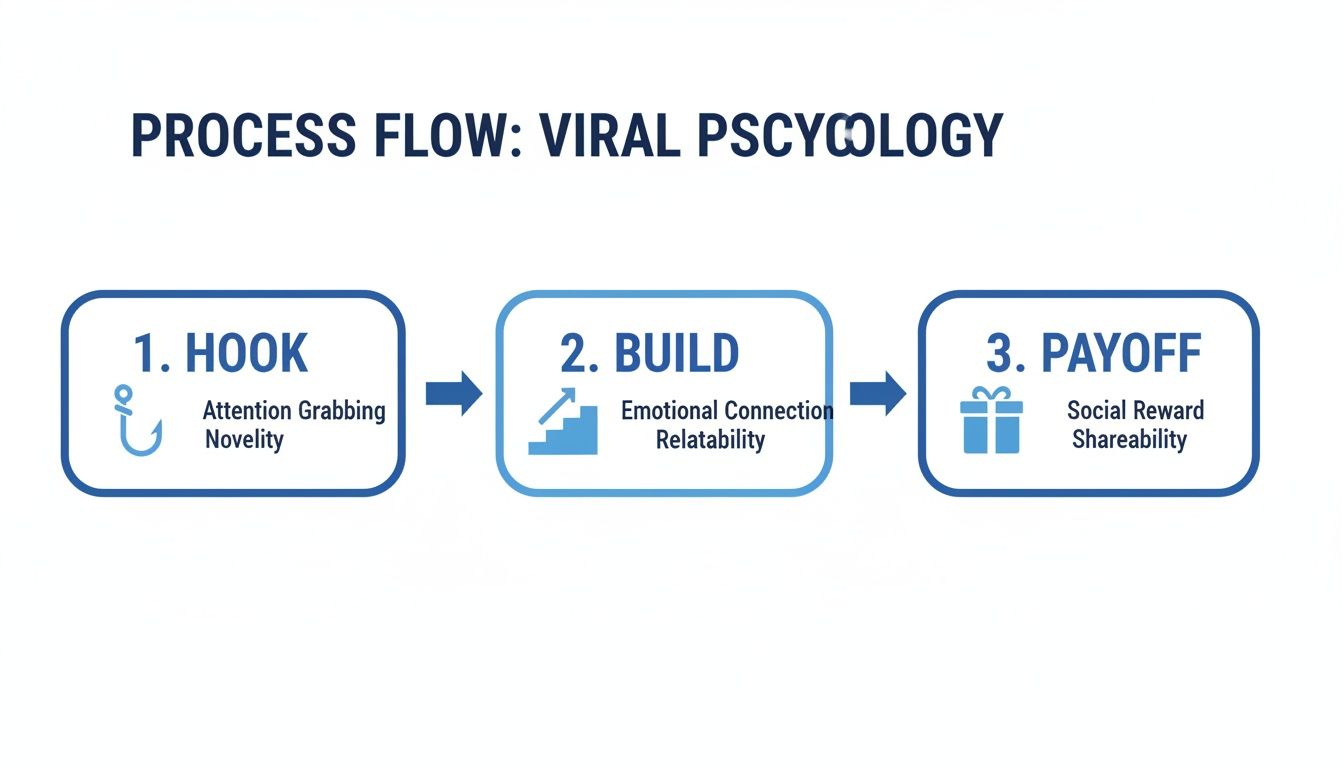
Nail this Hook -> Build -> Payoff flow, and you’re giving people a reason to stick around until the end.
Structuring Your Script for Maximum Impact
Okay, you’ve got your idea. Now it's time to script it. And I don't mean a 50-page screenplay. A short-form video script is a lean, mean blueprint. Every single word has to fight for its right to be there. No fluff allowed.
Don't just write what you want to say. Write what your audience needs to hear, in the fewest words possible. Clarity and brevity are your best friends.
To get past that intimidating blank page, don't reinvent the wheel. Lean on a proven scripting formula. These frameworks are like cheat codes for structuring your ideas in a way that’s psychologically satisfying for the viewer.
I've seen these formulas work time and time again for short-form content. They give you a solid structure to build upon, ensuring your video has a clear beginning, middle, and end that keeps people watching.
High-Impact Scripting Formulas for Short-Form Video
| Formula Name | Structure Breakdown | Best For |
|---|---|---|
| Problem-Agitation-Solution (PAS) | Start with a pain point. Magnify the frustration it causes. Present your product/tip as the hero. | Educational content, tutorials, product demos. |
| Hook-Story-Offer (HSO) | Grab attention with a bold claim or question. Tell a quick, relatable story. End with a clear call-to-action. | Storytelling, personal branding, driving traffic. |
| The "Before & After" Reveal | Show the undesirable "before" state. Dramatically reveal the transformed "after" state. | Visual transformations, DIY, fitness, beauty. |
Think of these structures as flexible guides, not rigid rules. They're here to organize your thoughts and make sure your video delivers a punch.
If you want to see how this all comes together in practice, our guide on taking a script into a finished video↗ walks you through the entire production flow. At the end of the day, a tight script is the foundation for everything that follows. Get this right, and you're already halfway to a video people can't stop watching.
Forget the Fancy Studio—Here's How to Create High-Retention Videos
You don't need a six-figure budget or a Hollywood-grade studio to create a video that glues people to their screens. I've seen countless creators go viral using just their phones. The real secret isn't the camera; it's the energy you create. High-retention videos are fast-paced, visually dynamic, and never give the viewer a reason to even think about scrolling away.
This is where your production chops come into play. Simple tactics like quick cuts, engaging B-roll footage, and smart on-screen visuals can transform a boring talking-head video into an unstoppable scroll-stopper. It’s all about building and maintaining momentum from the first second to the very last.
The Heartbeat of Your Video: Pacing and Visuals
Think of your video's pacing as its heartbeat. A slow, steady rhythm might work for a guided meditation, but on TikTok and YouTube Shorts, it’s a death sentence. You need a rapid, energetic pulse to keep viewers locked in.
So, how do you create that pulse? It comes down to a few key elements:
- Quick Cuts: Seriously, don't let any single shot linger for more than two or three seconds. Each cut acts as a mini "pattern interrupt," resetting the viewer's attention and pulling them deeper into your story.
- Dynamic B-roll: B-roll is any footage you cut away to. Instead of just showing your face, show what you’re talking about. Sharing a recipe? Show mouth-watering close-ups of the ingredients. Telling a wild story? Use stock footage or even simple images to paint the picture.
- On-Screen Text and Graphics: Animated captions, emojis, and simple graphics add a layer of visual candy that keeps the eyes busy. Plus, they reinforce your key points for the massive number of people watching with the sound off.
The goal here is to create a visually rich experience. Every single second of your video should offer something new for the eyes to process, making it impossible for someone's mind to wander.
This potent combination of fast pacing and visual variety is the bedrock of a video that can hold its own in a crowded feed.
How AI Is Leveling the Production Playing Field
For years, creating this kind of high-energy content was a huge bottleneck. It took time, technical skill, and often, expensive software. That's just not the case anymore. AI video generation is completely changing the game, allowing anyone—and I mean anyone—to produce polished, high-retention videos without ever touching a complex editing timeline.
Imagine just typing a prompt about your video idea. Within minutes, an AI tool can spit out a complete script, generate stunning 4K visuals to match, and add a professional, lifelike voiceover. This completely removes the technical hurdles, letting you focus purely on the creative side of things.
This is exactly what platforms like DailyShorts are built for. The tool is designed from the ground up to produce the kind of short-form content that both algorithms and real people love.

This approach is incredibly powerful. Instead of spending hours editing a single video, you can produce a dozen in the same amount of time. This lets you test more ideas, fail faster, and ultimately find what resonates with your audience way more quickly. If you're new to this whole workflow, this guide on how to create AI video↗ is a great place to start.
Tools and Techniques for Scrappy Creators
Even if you're not using AI, you can still produce amazing content on a shoestring budget. Today’s smartphones shoot incredible video, and a few smart techniques can make your footage look surprisingly professional.
- Good Lighting is Non-Negotiable: You don’t need expensive studio lights. A simple ring light is a game-changer. Even just positioning yourself in front of a bright window can make a massive difference in how clean your video looks.
- Clear Audio is Crucial: Viewers will forgive slightly grainy video, but they absolutely will not tolerate bad audio. A simple lavalier microphone that clips onto your shirt is an affordable investment that pays for itself immediately.
- Stabilize Your Shots: Shaky footage screams "amateur." Use a tripod. If you're on the move, try bracing your phone against a wall or a table to keep your shots smooth and watchable.
Let's be real: short-form videos are the undisputed kings of virality right now. Data shows that 71% of marketers report videos between 30 seconds and 2 minutes perform the best. This makes perfect sense when you consider that 63% of consumers prefer short-form content for discovering new things.
To get started without breaking the bank, check out some of the best content creation tools for social media↗ that can help you punch above your weight. The key is to be resourceful and focus on what truly matters: creating a dynamic viewing experience that makes people want to watch until the end.
Making Friends With the Algorithm
Look, you can create the most mind-blowing video ever, but if the algorithm decides to bury it, no one will ever see it. Getting your content to go viral isn't just about what you create; it's about how you package and deliver it.
You have to learn to play the game. This means feeding the algorithm precisely what it wants to see, turning it from a stubborn gatekeeper into your single biggest promoter. Forget the "post and pray" method—that’s a recipe for disappointment. Success on TikTok, YouTube Shorts, and Instagram Reels comes from understanding the signals that scream "show this to more people!"
Writing Captions That Get People Talking
Your caption is so much more than an afterthought—it's your secret weapon for engagement. A lazy caption is a huge missed opportunity. A great one, however, can kickstart a conversation that sends all the right signals to the algorithm, massively boosting your video's reach.
While the video's job is to stop the scroll, the caption's job is to drive people straight to the comments section.
- Ask real questions. Don't just ask for a "yes" or "no." Prompt a genuine response with something like, "What's the biggest mistake you see people making with this?"
- Give a clear call-to-action (CTA). Be direct. Tell them exactly what you want them to do. "Tag a friend who needs this" or "Drop your best tip in the comments" are simple, powerful, and they work.
- Share a (slightly) controversial take. Nothing gets the comment section fired up like a healthy debate. A little something like, "Unpopular opinion: this is the only way to do it right," can ignite a firestorm of interaction.
Every single comment, like, and share is a vote of confidence. It tells the platform that your content is valuable and worth pushing out to a much wider audience, creating that snowball effect we're all chasing.
Using Hashtags and Timing to Your Advantage
Hashtags aren't just for decoration. Think of them as signposts that tell the algorithm exactly what your content is about and who it should be shown to. A smart hashtag strategy is one of the best ways to get discovered by people who don't follow you... yet.
Your best bet is to use a strategic blend to cover all your bases:
- Broad, High-Traffic Tags: These are the big ones like #comedy or #lifehack. They have massive reach, but you're also competing with a ton of other videos.
- Niche-Specific Tags: Get targeted. Something like #VeganMealPrep or #ExcelTipsForBeginners connects you with a smaller but far more engaged audience that’s actively looking for your kind of content.
- Trending Tags: Always keep an eye on what's currently trending on the platform. Hopping on a relevant trend is like catching a wave—it can give you a huge, immediate boost.
Just as important as what you post is when you post it. Publishing a video when your audience is asleep is like performing to an empty theater. You need to hit them when they're actively scrolling. While every account is different, weekday lunch hours and evenings are usually a safe bet. For a more detailed breakdown, our guide on the best time to post Reels↗ has you covered.
Consistency is the algorithm's love language. If you post randomly, the platform sees you as a hobbyist. But a steady, reliable stream of content signals that you're a serious creator, and the algorithm will reward that dedication with more visibility over time.
Scale Your Content Without Burning Out
Trying to keep up this pace manually can feel absolutely draining. It’s a full-time job in itself, and that’s where you have to work smarter, not harder. Automation isn't cheating; it's a strategic advantage.
Imagine planning out your entire week of content in one session, then letting a tool post everything for you at the perfect times. That's exactly what you get with DailyShorts. Its Auto Pilot mode goes beyond simple scheduling—it actually posts your videos with optimized tags to maximize reach, all on its own.
This frees you from the daily grind of posting, so you can get back to what you're best at: coming up with killer video ideas. By scaling your output, you're not just saving time. You’re running more experiments, gathering more data, and dramatically increasing your odds of landing that next viral hit.
Using Analytics to Fuel Your Next Viral Hit
Going viral is almost never a lucky accident. The top creators I know and have worked with treat content creation like a science. They don't just post and pray; they publish, measure, and learn from every single video. This is the critical shift you need to make—from being just a creator to becoming a content strategist.
Think of your analytics dashboard as your personal cheat sheet. It’s a direct line into your audience's brain, showing you precisely what makes them lean in and what makes them scroll away. The goal here is simple: stop guessing what might work and start making decisions based on what is working. This data-driven feedback loop is how you turn a one-off hit into a repeatable system for growth.

Decoding Your Most Important Metrics
Diving into your analytics can feel like trying to drink from a firehose. But for viral potential, you only need to obsess over a few core numbers. These are the metrics that tell the algorithm whether your video is a dud or a certified banger worth pushing to millions.
To help you get started, here's a quick breakdown of what you should be looking for.
Key Short-Form Video Metrics and What They Mean
| Metric | What It Measures | Why It's Important for Virality |
|---|---|---|
| Audience Retention | The percentage of viewers still watching at any point in your video. | A sharp drop in the first 3 seconds means your hook failed. A high, flat line is the holy grail. |
| Average Watch Time | The average duration that people watch your video. | This signals deep engagement. The longer people watch, the more the platform will promote it. |
| For You Page Views | (TikTok/Reels) The percentage of views from algorithmic discovery vs. followers. | A high percentage (over 80%) means your video has broken out of your audience and is going viral. |
| Shares | The number of times viewers shared your video. | This is a powerful signal of value. People only share what makes them look good or feel something. |
These metrics are more than just data; they’re telling you a story. For instance, a video with tons of early views but a terrible retention rate tells you the title was great, but the content didn't deliver on the promise. That’s pure gold for your next script.
If you want to dig deeper into the relationship between views and retention, our guide on how to get views on YouTube Shorts↗ is a great next step.
Finding the Patterns in Your Success
Once you have a handful of videos live, it’s time to put on your detective hat. Pull up your top three performing videos and look for the common threads. Don't just glance at the topic—dissect every single element.
Ask yourself these questions:
- The Hook: Did you start with a controversial statement? A wild visual? A relatable "you know when..." moment?
- The Format: Was it a talking head video? A screen recording with a voiceover? A quick-cut tutorial?
- The Pacing: Did you use lightning-fast jump cuts every 2 seconds? Or did you let a shot linger for dramatic effect?
- The CTA: Did you end by asking a specific question that drove hundreds of comments?
When you identify these winning ingredients, you start to build a "success template" unique to your channel. This isn't about pumping out cookie-cutter videos. It's about understanding the core psychology of what makes your audience tick and applying those principles to fresh ideas.
Your audience is constantly telling you what they want to see through their behavior. The analytics dashboard is simply the translator. Ignore it, and you're flying blind.
Iterating and Testing at Scale
The final piece of this puzzle is speed. The faster you can test new ideas based on what your data is telling you, the faster you'll grow. This is where most creators hit a wall. Manually producing enough high-quality content to test everything is an exhausting, uphill battle.
This is exactly where a tool like DailyShorts↗ becomes your unfair advantage. Instead of spending hours scripting and editing a single video, you can generate multiple variations of a winning concept in minutes.
Let's say your analytics show that videos starting with a "Here are 3 mistakes you're making..." hook get insane watch time. With an AI tool, you can instantly create five different videos using that same hook but for different topics in your niche. This lets you test new concepts at a scale that's physically impossible otherwise, supercharging your learning curve and dramatically increasing your odds of striking viral gold again and again.
Your Top Questions About Going Viral, Answered
Every creator trying to crack the code on virality asks the same questions. I've heard them all, and I've lived through them myself. So, let's cut through the noise and get you some straight answers based on real experience.
Do I Have to Follow Every Single Trend?
Heck no. In fact, you absolutely shouldn't. Chasing every trend is the fastest way to burn out and make your content look like a cheap copy of everyone else's.
The real trick is to be selective.
Instead of hopping on every sound or format that pops up, keep an eye out for trends that genuinely click with your niche and your personal style. The magic isn't in doing the trend; it's in putting your unique spin on it. When you can adapt a popular format to deliver value or entertainment that’s specific to your audience, you get the best of both worlds: discoverability and authenticity.
Seriously, How Long Does It Take to Go Viral?
Ah, the million-dollar question. The honest-to-god answer? It’s a total crapshoot. Some creators strike gold on their tenth video, while others are a year in before one finally explodes. There’s just no predictable timeline.
But you can stack the odds in your favor by being relentlessly consistent. Think of every video not as a lottery ticket, but as another data point and another shot at getting the algorithm's attention.
Virality isn't a destination you arrive at. It’s the natural outcome of a solid, consistent content system. Focus on the process of making great videos, and the viral hits will follow.
Stop fixating on how one video performs. Start thinking in 30, 60, and 90-day sprints. A creator who posts consistently and learns from their analytics will always, always beat the person who just posts once in a while, hoping to get lucky.
Should I Delete Videos That Flop?
I know it’s tempting to tidy up your feed and get rid of the duds, but fight that urge. In most cases, you should leave them right where they are. A video that looks dead on arrival today could be a "sleeper hit" that wakes up next month.
Here’s why you should just let them be:
- The Delayed Push: I’ve seen it happen dozens of times. A platform’s algorithm will randomly pick up an old video weeks or even months later and give it a whole new life.
- It's Valuable Data: A flop is a lesson. It tells you what your audience doesn't want, which is just as crucial as knowing what they love.
- Niche Loyalty: A video with low views might still have hit home with a small, core part of your audience. Those are the people who become your true fans.
The only real reason to delete a video is if it has bad information or just doesn't align with who you are anymore. Otherwise, let it live.
How Many Hashtags Should I Actually Use?
Forget the magic number—quality beats quantity every time. Jamming your caption with 30 random hashtags just looks spammy and desperate. A much smarter approach is to use a strategic mix of about 5-8 highly relevant tags.
A great hashtag strategy is a simple recipe:
- Broad Tags (1-2): These tell the algorithm the general topic. Think
.Code Snippet#MarketingTips - Niche Tags (2-3): These attract your perfect audience. Something like
.Code Snippet#ShortFormVideoStrategy - Unique/Branded Tags (1): This is one that’s all yours, for your channel or a specific series.
This balanced approach gives the algorithm a clear roadmap to your ideal viewer without looking like you're trying too hard. Nailing this is a huge piece of the puzzle for how to make a viral video that breaks out of your bubble.
Can I Just Repost My Content Everywhere?
You can, but you have to be smart about it. Just downloading your TikTok and throwing it up on Reels—watermark and all—is lazy. The algorithms notice, and they often suppress that content. Each platform has its own vibe, its own culture.
For the best results, you need to adapt. It doesn't have to be a total overhaul. Sometimes it's as simple as swapping the audio for a trending sound on that specific app, rewriting the caption to fit the platform's style, or changing the on-screen text. The core video can stay the same, but these small tweaks show you actually get it.
Ready to stop guessing and start creating viral-ready content at scale? DailyShorts is your AI-powered partner for turning simple ideas into polished short-form videos in minutes. Generate scripts, create 4K visuals, add lifelike voiceovers, and let Auto Pilot post for you 24/7. Join over 50,000 creators and start building your audience today. Try it for free at https://dailyshorts.ai↗.
Ready to create viral videos?
Start creating viral TikTok and YouTube Shorts with DailyShorts AI today.