How to get views on youtube shorts: Simple tactics to boost reach
DailyShorts AI
If you want to get more views on your YouTube Shorts, you need to get inside the algorithm's head. But here's the secret: you don't need a computer science degree to figure it out.
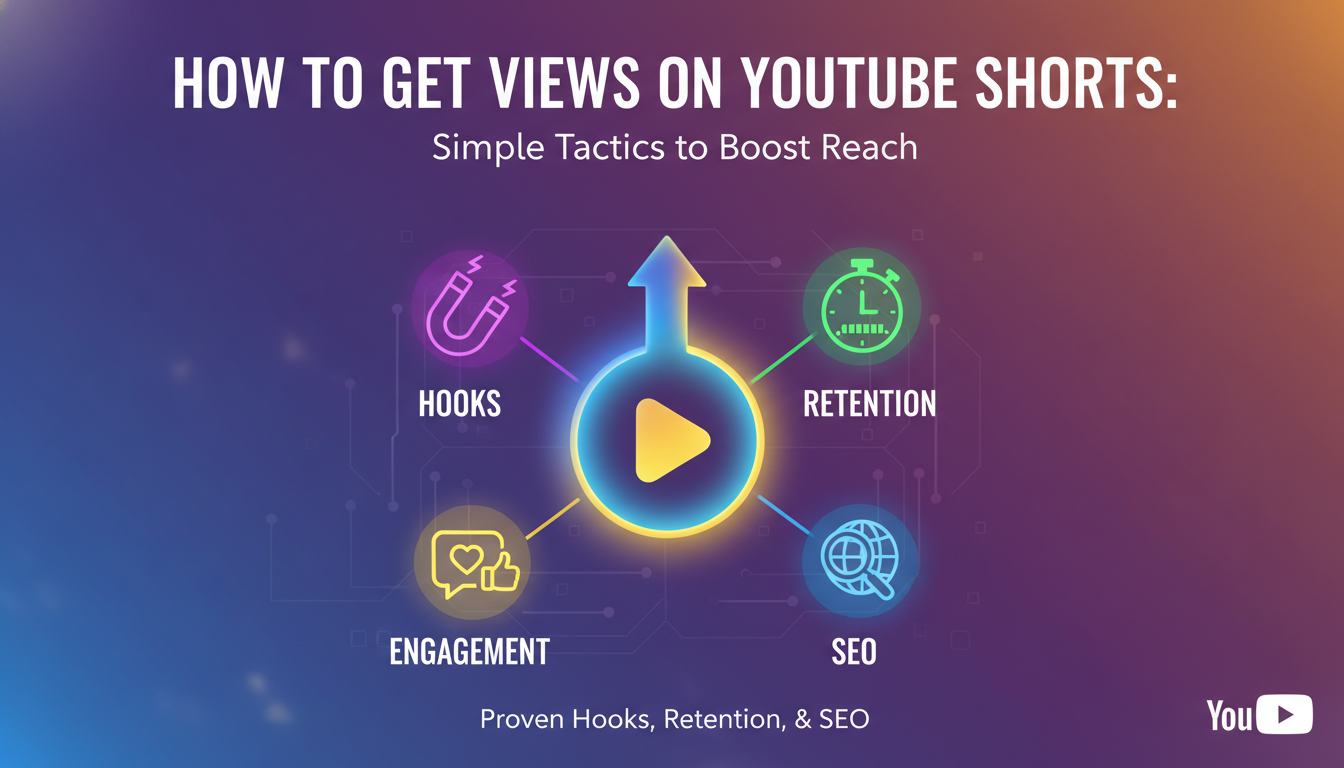
The whole game boils down to four simple things: grabbing attention with a killer hook, keeping people watching (retention), sparking a reaction (engagement), and making your content easy to find (discoverability). Nail these, and you’re signaling to YouTube that your stuff is worth pushing to a massive audience.
Getting the YouTube Shorts Algorithm to Work for You
First, stop thinking of the algorithm as some mysterious gatekeeper. It’s more like a matchmaker. Its only job is to pair viewers with Shorts they'll love so much they stick around on YouTube. It’s less about how many people watch and more about how they watch.
Viewer satisfaction is the name of the game, and YouTube measures it with some pretty specific signals. When you post a Short, it gets a trial run with a small group of people. If that initial audience eats it up, YouTube pushes it out to more people, then more, and so on. This ripple effect is why a Short can suddenly blow up hours, days, or even weeks after you've posted it.
The Signals That Actually Matter for Views
The algorithm is constantly watching a few key metrics to figure out if your content is a hit or a miss. These aren't hidden secrets; they're the bedrock of what makes any video compelling.
- Audience Retention: This is the big one. What percentage of your video do people actually watch? A high retention rate screams, "This Short is captivating!"
- Quick Engagement: Early likes, comments, and shares are gold. They tell the algorithm your content made an immediate impact and got people to act.
- Session Watch Time: Does your Short make someone want to watch more Shorts? If you can keep people on the platform, YouTube sees your content as a major asset.
This whole process is a chain reaction. It all starts with the hook.
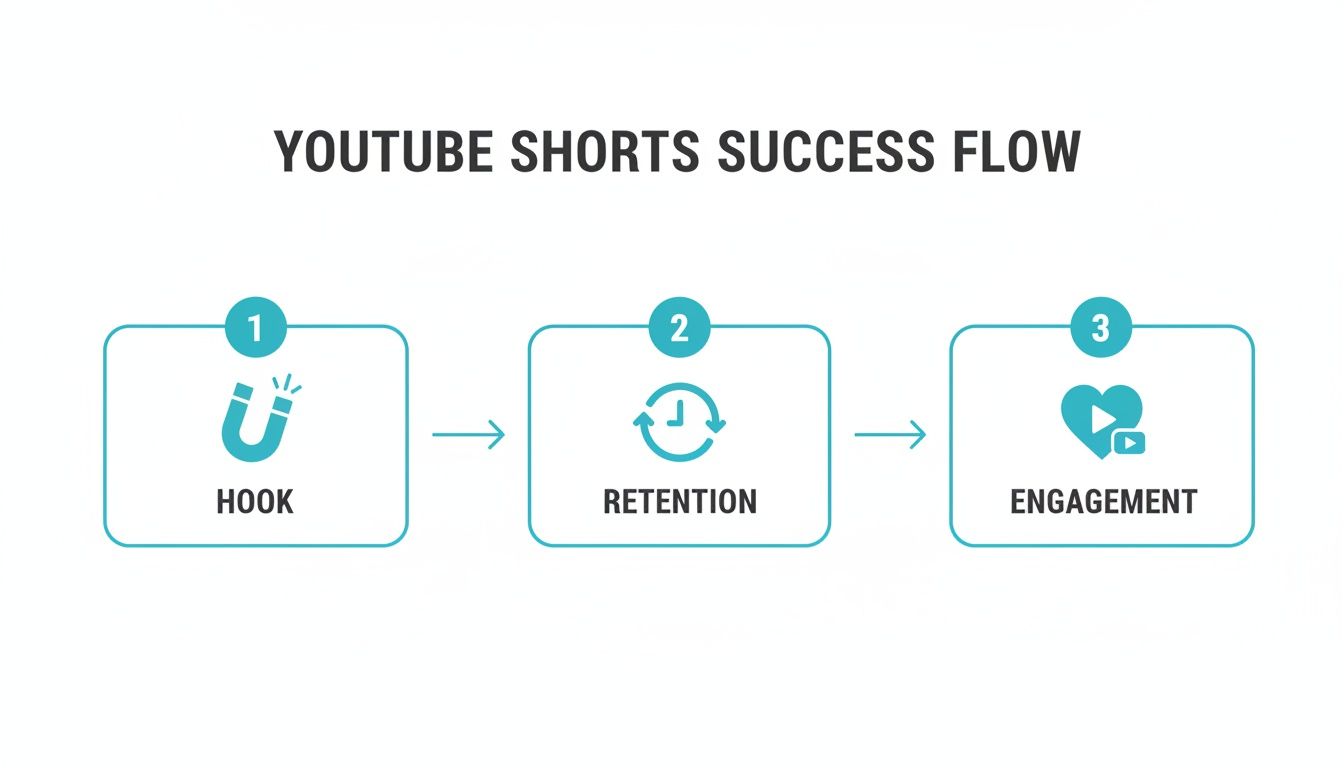
As you can see, a powerful hook is your entry point. It leads directly to retention, which in turn drives the engagement that gets the algorithm's attention.
Let's break down these pillars into a quick reference.
Core Pillars for YouTube Shorts Success
Here’s a snapshot of the four essential components for getting more views on your YouTube Shorts.
| Pillar | Why It Matters | Actionable Tip |
|---|---|---|
| Hook | Captures attention in the first 1-3 seconds to stop the scroll. | Start with a question, a bold claim, or a visually jarring clip. |
| Retention | High watch-through rates signal to the algorithm that the video is valuable. | Use quick cuts, on-screen text, and a clear narrative to hold interest. |
| Engagement | Likes, comments, and shares are direct proof of viewer satisfaction. | End with a clear call-to-action that encourages comments or shares. |
| Discoverability | Helps the algorithm categorize and serve your content to the right audience. | Use relevant keywords in your title and a few strategic hashtags. |
Focusing on these four areas in every single Short is how you build momentum and consistently grow your channel.
Why Retention Is Your North Star
With over 70 billion daily views on YouTube Shorts, the fight for eyeballs is intense. But that huge number also means there's a massive audience just waiting to find you.
The secret to tapping into it? Obsess over retention.
Based on what we've seen, Shorts that hit an average viewer retention of around 73% have a much, much higher chance of going viral.
The YouTube algorithm doesn't judge your video's quality—it just analyzes how people react to it. Your job is to delight your audience, not the algorithm. The algorithm will simply follow their lead.
If you want to dig deeper into the mechanics of short-form video, it's worth understanding how the Instagram Reel algorithm works↗. You'll see a lot of overlap; both platforms are built to reward content that captures and holds attention fast.
This means every single second of your Short has a job to do, but those first three seconds are make-or-break. If you can stop the scroll and keep them hooked, you've already won half the battle. And if you're looking to create high-retention content faster, check out our guide on https://dailyshorts.ai/blog/how-to-create-ai-video↗ to see how new tools can streamline your workflow.
Crafting Hooks That Stop the Scroll Cold
In the world of YouTube Shorts, you don’t get a second chance to make a first impression. Forget a gentle warm-up; you have maybe three seconds—if you're lucky—to convince someone your video is worth their time.
The algorithm might serve your video up on a silver platter, but it's the viewer who decides its fate with a flick of their thumb. If your opening is weak, you’ve already lost. They're gone.
A powerful hook is the single biggest lever you can pull to drive up audience retention. It’s an unspoken promise to the viewer that says, "Stick around, this is going to be good." A great hook opens a loop in their mind, posing a question they suddenly feel a deep need to have answered. It makes scrolling away feel like leaving a movie right before the big reveal.
Proven Hook Formulas That Actually Work
You don't need to reinvent the wheel for every single Short. The best creators I know have a toolkit of proven formulas they pull from again and again. The magic is in adapting these frameworks to your own niche and voice so they feel completely natural.
Here are a few battle-tested hook formulas you can start using right now:
-
The "Problem-Agitate-Solve" Hook: Tap into a common frustration your audience has. First, state the problem. Then, poke the bear a little—agitate it to make it feel more urgent. Finally, promise them the solution they’ve been looking for. A fitness creator might say, "Hate boring workouts? Can't stand another minute on the treadmill? Here’s a 10-minute routine that's actually fun."
-
The "Unexpected Outcome" Hook: This one is all about piquing curiosity. You set up a scenario that sounds completely bizarre and promise a surprising result. For example, a cooking channel could open with, "I mixed pickles and ice cream, and you will not believe what happened." Who wouldn't stick around to see that train wreck?
-
The "Bold Statement" Hook: Make a claim that challenges a core belief in your niche. It can be a little controversial, but it has to be bold. A personal finance creator could hit them with, "Everything you've been told about saving money is a lie." That kind of opening instantly makes the viewer question what they know and positions you as someone with a secret worth hearing.
Mastering these formulas gives you a reliable system for starting your videos with a bang. For a deeper dive, you'll find more actionable tips on crafting effective hooks for YouTube Shorts↗ that can really take your intros to the next level.
The Power of Visual Hooks
Sometimes, the best hook isn't a line of dialogue at all. It's purely visual. A killer visual hook can stop a scroller dead in their tracks before you've even said a word, which is a massive advantage in a silent, auto-playing feed.
Think about how you can create an immediate visual jolt. This could be anything from:
- Jarring Cuts: Start with a super-fast, almost disorienting cut that breaks the hypnotic rhythm of scrolling.
- Dynamic Motion: Kick things off with quick movement, like rushing toward the camera or a whip pan that creates instant energy.
- Surprising Text Overlays: A huge text overlay that says "DO NOT TRY THIS" or "My Biggest Mistake Ever" is almost impossible to ignore.
Your first frame is your thumbnail, title, and opening line all rolled into one. It has to be visually compelling enough to earn you the next second of their attention.
The goal here is to create a pattern interrupt. When every other video in the feed looks the same, a unique visual opening makes your Short pop. This is especially crucial if you're trying to turn ideas or scripts into something visually dynamic. In fact, if you're looking for ways to do just that, our guide on turning a script into a high-quality video↗ shows how modern tools can help automate this.
Testing and Refining Your Hooks
Look, crafting the perfect hook isn't an art—it's a science. What resonates with my audience might fall completely flat with yours. The only way to know for sure is to test, test, and test again while letting the data be your guide.
Dive into your YouTube Analytics for each new Short and pay close attention to that audience retention graph.
-
Analyze the First 3 Seconds: Do you see a steep cliff where viewers are bailing immediately? That’s a dead giveaway your hook isn't working. A flat line or even a slight upward tick at the start is the gold standard.
-
Compare Different Openings: Don't be afraid to A/B test your hooks. Try a question-based hook today and a bold statement tomorrow on similar videos. See which style consistently keeps people watching longer.
-
Find Your Patterns: Go look at your top 5 best-performing Shorts right now. What do their openings have in common? Is there a specific formula or visual style that’s clearly a winner? Find it, and double down on it.
This data-driven feedback loop takes the guesswork out of the equation. By constantly analyzing and iterating, you'll build an instinct for what grabs your audience and turns a casual viewer into a loyal subscriber.
Your Production Blueprint for High-Retention Shorts
Okay, so you’ve nailed the hook. That's your ticket in the door. But what happens in the next 57 seconds is what really matters. This is where you win or lose the retention game. High retention is the most powerful signal you can send the YouTube algorithm, screaming, "This content is good, show it to more people!"
Forget expensive cameras or Hollywood editing software. This is about making smart, strategic choices that glue eyeballs to the screen.
The whole game is about momentum. Every single cut, every sound effect, every animated caption has one job: to push the viewer to the next second, and the next, all the way to the end. The moment you give them a reason to pause or get confused, they're gone. And they don't come back.
Tools like DailyShorts↗ are popping up to help creators build these high-retention videos with AI, which can seriously speed up the process from script to final cut.
This is a huge help for keeping your production workflow consistent, which is key to pumping out engaging content regularly.
Architecting Your Short for Maximum Watch Time
Think of your Short less like a video and more like a tiny, self-contained story. Even a 30-second clip needs a clear beginning, middle, and end to feel satisfying. This structure gives the viewer a mental roadmap, getting them invested in seeing how it all plays out.
Without that arc, your Short is just a random jumble of clips. But a simple narrative—even a super basic one—turns it into an experience. The easiest way to do this is with a classic setup-and-payoff structure.
- The Setup: This comes right after your hook. It quickly sets the scene or the challenge. Think, "I'm going to try to turn this old pallet into a coffee table in under 60 seconds."
- The Journey: This is the fast-paced middle. You're showing the process with quick cuts, time-lapses, and dynamic B-roll. Seriously, don't let any single shot linger for more than a second or two.
- The Payoff: This is the grand finale, the satisfying reveal where you deliver on the promise you made in the hook. It's the finished coffee table, the punchline to the joke, or the shocking result of the experiment.
This little narrative trick keeps people watching because it builds anticipation. They have to see the payoff.
Using Visuals to Eliminate Every Dull Moment
In the Shorts universe, visual boredom is your worst enemy. Your mission is to create a dynamic visual experience that constantly feeds the viewer's brain something new to process. This is where your editing chops and visual aids become your secret weapons.
Captions and On-Screen Text: Don't just slap on default subtitles. Use animated captions that pop onto the screen word-by-word. This forces the viewer's eyes to follow along, turning them from a passive watcher into an active participant. Use bold text, emojis, and color to punch up key points and add another layer of visual energy.
B-Roll and Pattern Interrupts: Never, ever stay on a single static shot for too long. If you're talking to the camera, constantly break it up with relevant B-roll clips that illustrate what you're saying. If you're showing a process, cut to close-ups and different angles. This constant change of scenery acts like a mini-reset for the viewer's attention span.
My rule of thumb for Shorts is ruthless: if a shot doesn't serve a purpose, it gets cut. You have to be merciless in your editing to maintain that lightning-fast pace that keeps people locked in.
For anyone trying to dial in their workflow, figuring out how to make videos for social media↗ without burning out is a huge win. This is where modern AI tools can be a massive help, generating engaging B-roll or even professional AI voiceovers to make sure there are absolutely no dead spots in your audio or visuals.
The Unspoken Power of Audio
Great audio is the secret weapon of top-tier Shorts. The visuals might grab the initial attention, but it's the audio that controls the mood, dictates the pace, and drives the emotional impact. A Short with flat, boring audio will feel cheap, no matter how good it looks.
Here's how to get your sound on point:
- Use Trending Sounds (Strategically): Hopping on a trending sound can give you a nice discovery boost, but don't just slap a popular song on a random video and call it a day. Find a trend that actually fits your content's story and adds a new layer of humor or meaning.
- Add Sound Effects (SFX): This is one of the most overlooked—and most effective—production tips I can give. Add subtle "whoosh" sounds for transitions, a "ding" when a key point appears on screen, or a "pop" for text animations. These tiny audio cues make your video feel incredibly polished and satisfying to watch.
- Prioritize Clear Voiceovers: If you're using a voiceover, it must be crisp and clear. Get rid of background noise and make sure your audio levels are balanced. An AI voiceover tool can be a lifesaver here, giving you a consistently professional narration without needing a pricey microphone setup.
To help you put all this into practice, here's a quick checklist to run through during your production process.
Shorts Production Checklist for High Retention
Follow these steps during production to ensure your Short is primed to keep viewers watching until the very end.
| Element | Objective | Implementation Example |
|---|---|---|
| Pacing | Eliminate any slow moments | Keep cuts under 2 seconds; use time-lapses for longer processes. |
| Visuals | Keep the screen dynamic and engaging | Add animated captions, B-roll, and zoom effects. |
| Audio | Enhance the mood and energy | Use trending music, add SFX for actions, ensure voiceover is clear. |
| Narrative | Create a reason to keep watching | Structure your video with a clear setup, journey, and payoff. |
| Captions | Make content accessible and engaging | Use bold, colorful text that appears word-by-word to guide the eye. |
By combining a tight narrative with dynamic visuals and immersive audio, you're building a Short that doesn't just get started—it gets finished. That high completion rate is exactly what you need to convince the YouTube algorithm that your content is worth a much, much bigger audience.
Mastering YouTube Shorts SEO and Trend Surfing
Look, you can create the most mind-blowing Short in the world, but if nobody finds it, it doesn’t matter. Once you’ve nailed your hook and edited a video that keeps people watching, you have to focus on discoverability. This is where the magic really happens—turning a great Short into a viral one by smartly playing the game of SEO and trend surfing.
Think of it this way: SEO is like giving your video a permanent, searchable address on the YouTube map. Trend surfing is like putting that same video on a giant, flashing billboard during rush hour. You need both to truly blow up.
Optimizing Your Shorts for Search and Discovery
Even though the Shorts feed feels like the main event, a surprising number of views actually come from people searching for things. That's why your metadata—the title, description, and hashtags—is absolutely non-negotiable. It's your direct line of communication to tell YouTube what your video is about and exactly who needs to see it.

The algorithm is brilliant, but it's not a mind reader. You have to feed it clear, keyword-focused signals so it can serve your content to the right audience, which is what sparks that crucial initial engagement.
H3: Crafting Keyword-Rich Titles
Your title has to pull double duty: it needs to be compelling enough for a human to click while also being descriptive enough for the algorithm to understand. The sweet spot is a blend of a solid keyword with a hook that sparks curiosity.
- Weak Title: "Cool Drone Shots"
- Strong Title: "You Won't Believe This Drone Shot I Got"
The second one still hits the "drone shots" keyword but frames it in a way that makes you have to see what the fuss is about. It’s both searchable and irresistible.
H3: Writing Descriptions That Feed the Algorithm
Most people won’t read the description on a Short, but you can bet the algorithm does. I always use the first couple of lines to expand on the title, weaving in my main and secondary keywords naturally. A quick 2-3 sentence summary is perfect.
H3: Using Hashtags Strategically
Please, don't just dump a list of 50 generic tags in your description. That just looks spammy. A much more effective strategy is to be surgical with your choices.
- One broad tag: Like Code Snippet
#DIY - Two niche-specific tags: Something like
andCode Snippet#woodworkingCode Snippet#furnitureflip - The essential tag: And, of course, always include Code Snippet
#shorts
This combo helps YouTube categorize your content with precision. This level of detail matters more than you think. Since 2020, Shorts have racked up over 5 trillion views. In a crowded space like video games, which saw 469k uploads in just the first half of 2023, that mix of niche focus and discoverability is what separates the top creators from everyone else. You can dig deeper into the numbers with these YouTube Shorts growth stats from routenote.com↗.
The Art of Trend Surfing
SEO is your long-game, your foundation. Trend surfing? That's your sprint. It’s about catching lightning in a bottle by jumping on trending sounds, formats, and challenges right before they hit their peak. When you get the timing right, you’re not just making a video; you’re riding a massive wave of attention that can bring a flood of new viewers to your channel.
Trends are temporary boosts, but the viewers they bring can become permanent subscribers if your content delivers value. Use trends as an introduction, not a crutch.
H3: Finding What's Hot Right Now
You don’t need a crystal ball to spot a rising trend. YouTube gives you all the clues you need.
- Explore the Shorts Feed: Seriously, just spend 15 minutes a day scrolling. What sounds do you keep hearing? What editing tricks are popping up over and over? This is your ground-level intelligence.
- Check the YouTube Trending Page: While this page is mostly long-form, it’s a great barometer for what topics are capturing the cultural zeitgeist. Think about how you can adapt those bigger themes into a quick, punchy Short.
- Use Third-Party Tools: Some platforms are built to track what’s bubbling up on TikTok, which is often a predictor for what will be big on Shorts next week. Get ahead of the curve.
When you spot a trend that fits your niche, you have to move fast. The lifecycle of a viral sound can be just a few days. For creators needing to produce content quickly, learning how to transform an image sequence into a video↗ can be a total game-changer, letting you spin up trendy, video-style content from static images in minutes.
By pairing rock-solid SEO with nimble trend surfing, you build a powerful, two-pronged strategy that will consistently get more eyes on your YouTube Shorts.
Weaving Content and Promotion into a Growth Engine
Look, creating a killer Short is only half the battle. You could make the most brilliant, engaging video in the world, but if nobody sees it, it's just a file on your hard drive. This is where a smart, consistent promotion strategy comes in—it’s the difference between a hobby and a reliable system for channel growth.
Getting more eyeballs on your Shorts isn't about chasing one viral hit. It's about building momentum. The YouTube algorithm absolutely loves consistency, not just in the quality of your videos but in how often you show up. When you post on a regular schedule, you're sending a powerful signal that your channel is active and a reliable source of content for viewers.
Finding Your Posting Rhythm
So, what's the magic number? How often should you be posting? Honestly, there isn't one. Most creators who are serious about growth aim for at least 3-5 Shorts per week, but I've seen channels explode by posting multiple times a day.
The real secret is finding a pace you can stick to without burning out or letting the quality slip.
- Try starting with one Short a day. This gives the algorithm a steady stream of content to test with different pockets of viewers.
- Keep a close eye on your analytics. If you notice your videos are getting sloppy because you're rushing, it's okay to scale back to every other day.
- Consistency always wins over raw quantity. A single great Short every two days will do far more for your channel than three mediocre ones you threw together in a panic.
Once you find a rhythm that works, lock it in. This trains both the algorithm and your audience to know when to expect new stuff from you, which makes your growth much more predictable.

This steady beat is the foundation of your entire promotional plan. It gives you a constant supply of new content to push out and amplify everywhere else.
Timing is Everything (Sort of)
Now, YouTube will tell you that posting time isn't a direct ranking factor. And they're not wrong, but posting when your audience is actually online gives your Short the best possible launchpad. That initial burst of views and engagement from your subscribers is often the spark that tells the algorithm, "Hey, people like this! Let's show it to more people."
To find your channel's prime time, head into your YouTube Studio > Analytics > Audience tab. You're looking for the "When your viewers are on YouTube" chart. Those dark purple bars? That's your golden window.
Here's a pro tip: Don't post exactly at the peak hour. Aim to publish an hour or two beforehand. This gives YouTube's system time to index your video and start testing it, so it's primed and ready to go right as your audience starts scrolling.
Scheduling your posts ahead of time is an absolute game-changer for staying consistent. If you need a hand with that, our guide on how to schedule YouTube videos↗ breaks it all down for you, step by step.
Don't Let Your Content Die on One Platform
Never, ever let your Short exist only on YouTube. Your mission is to drive as much initial traffic as you can from every corner of the internet. Think of it like creating multiple front doors that all lead back to your video.
Repurpose Your Shorts and Go Wide Every social platform has its own vibe and audience. A Short that does just okay on YouTube might absolutely take off somewhere else, sending a wave of new viewers back to your channel.
| Platform | Your Repurposing Play | Why It's a Smart Move |
|---|---|---|
| TikTok | Post the same video, but swap the audio for a sound that's trending on TikTok. | This taps directly into TikTok's audio-driven discovery engine, which is insanely powerful. |
| Instagram Reels | Share your Short to Reels and then immediately re-share it to your Instagram Stories. | You capture your existing Instagram followers and make it super easy for them to share it within that ecosystem. |
| Upload your Short as an Idea Pin and be sure to include a link back to your channel. | You'll get in front of Pinterest's massive, search-focused audience that is actively looking for ideas and inspiration. |
This isn't just about recycling content—it's about multiplying its potential reach.
And don't forget about your existing YouTube assets! Announce new Shorts on your Community Tab with a question to get a conversation started. If you have a blog, embed your Shorts directly into relevant articles. Every bit of this external traffic sends a strong signal to the algorithm that your content is worth watching, helping you lock in those critical early views.
Answering Your Biggest Questions About YouTube Shorts Views
Even with a solid game plan, the world of YouTube Shorts can throw some curveballs. Let's tackle a few of the most common questions I hear from creators who are trying to crack the code on getting views. Getting these answers straight will help you troubleshoot problems and tweak your strategy like a pro.
So, you've uploaded a Short, it starts to get some traction, and then… crickets. It's incredibly frustrating, but this isn't a glitch. It's just the algorithm doing its job.
Here’s what’s happening behind the scenes: YouTube pushes your Short to a small, handpicked audience to see how they react. If that group loves it—watches it multiple times, shares it, likes it—the system pushes it to a slightly bigger, broader audience.
The “flatline” happens when the Short performs well with one group but completely flops with the next. Maybe your hyper-niche joke landed perfectly with your core subscribers but went right over the heads of a general audience. When that happens, YouTube slams the brakes on the rollout. It’s a clear signal that your video has a very specific appeal but might not be built for a massive, mainstream audience.
Do Hashtags Actually Do Anything for Views?
Yes, but their role is massively misunderstood. If you're stuffing your description with dozens of generic hashtags hoping to trick the algorithm, you’re wasting your time. YouTube’s system is smart; it primarily looks at your title, what you say in the video, and the on-screen visuals to figure out what your content is about.
Instead, think of hashtags as precise signposts, not a giant map. A few strategic tags are all you need.
- You absolutely must include
: This is the one non-negotiable tag. It’s the official signal to YouTube that your video belongs in the Shorts feed.Code Snippet#shorts - Add 2-3 highly relevant tags: These help the algorithm pinpoint your exact audience. If you made a video on sourdough starter, you’d use something like
andCode Snippet#sourdoughbaking
, not justCode Snippet#breadmaking
.Code Snippet#cooking - Skip the useless, broad tags: Hashtags like
,Code Snippet#viral
, orCode Snippet#trending
do nothing. They're too generic to help the algorithm find the right people who will actually enjoy your video.Code Snippet#foryou
A few well-chosen hashtags can give the algorithm a helpful nudge in the right direction, ensuring your Short gets tested with the most receptive audience right from the start.
Help! Why Did My Views Suddenly Drop Off a Cliff?
Seeing your views nosedive across your whole channel can be terrifying, but it’s rarely a sign that your content quality has suddenly tanked. More often than not, it's the algorithm itself. YouTube is constantly tweaking and updating how it recommends videos, and sometimes those changes can temporarily mess with your distribution. It happens to everyone, even the biggest creators.
Another culprit is plain old viewer fatigue. If every single Short you post is the exact same format, your audience might get bored and start scrolling past. Those "skip" signals tell the algorithm that interest is dropping. This is your cue to shake things up—try a new editing style, tackle a different angle on your topic, or experiment with a new trend to keep things fresh.
Remember this: The YouTube algorithm follows the viewers, not the videos. If you focus on making content that genuinely entertains and provides value to your audience, the algorithm will eventually reward you for it.
The bottom line? Don't panic over short-term dips. Keep your eyes on the long-term trends in your analytics and stick to creating great content.
So, How Long Does It Take for a Short to Go Viral?
This is the million-dollar question, and the answer is… there isn't one. A YouTube Short can blow up in hours, days, weeks, or even months after you post it. This is a huge difference from platforms like TikTok, where content has a much shorter shelf life.
YouTube’s algorithm is constantly digging through its library, looking for hidden gems. If a new trend suddenly makes one of your old Shorts relevant again, the system might dust it off and start showing it to a whole new audience. This is why creating "evergreen" content—videos that stay relevant over time—is such a powerful strategy.
A Short that gets a disappointing 100 views in its first 24 hours could suddenly rack up 100,000 views a month later without you doing a thing. Patience is key.
Ready to stop guessing and start creating high-retention Shorts in minutes? With DailyShorts, you can turn any idea into a polished, viral-ready video with AI-powered scripts, visuals, and voiceovers. Join over 50,000 creators and start making amazing content today at https://dailyshorts.ai↗.
Ready to create viral videos?
Start creating viral TikTok and YouTube Shorts with DailyShorts AI today.