How to Make Videos for Social Media That Actually Get Views
DailyShorts AI
Knowing how to make great videos for social media really boils down to a simple, repeatable system. It's about nailing three core things: brainstorming an idea that actually connects with your audience, creating visuals and audio that grab them, and finally, publishing it with the right optimizations for each platform. This guide is built to give you that exact system—an actionable process for churning out scroll-stopping content without all the usual headaches.
Your Framework for High-Impact Social Media Videos
Welcome to your no-fluff guide to making social videos that actually work. We're skipping the theory and diving straight into a practical framework that takes you from a fuzzy concept to a polished, high-performing video. This is for the marketers and creators out there who need to produce killer content but can't afford to get bogged down in complicated, time-sucking workflows.
This whole process can be broken down into three simple, repeating phases.
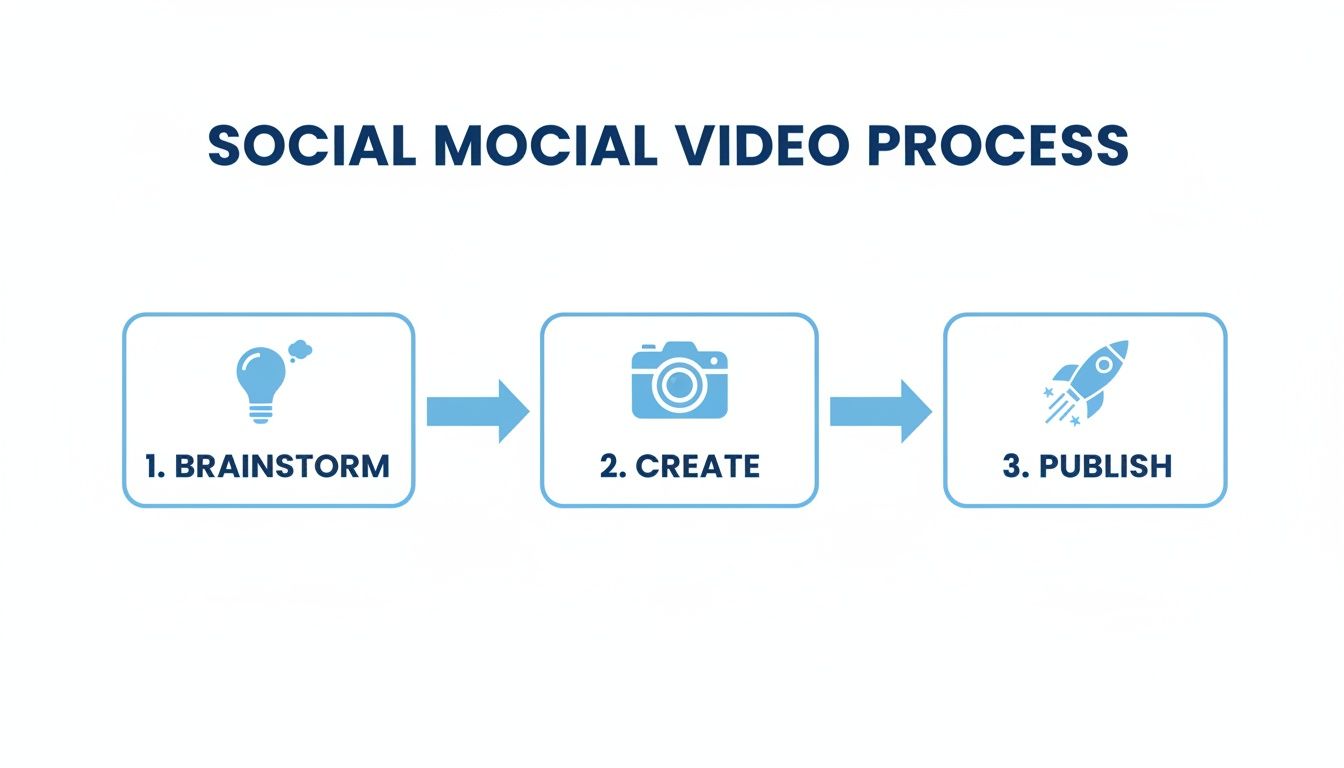
By focusing everything you do around these three pillars—Brainstorm, Create, and Publish—you’re not just making a single video; you're building a scalable content engine.
Why You Can't Afford to Ignore Video
Let's be clear: having a video-first content strategy isn't a suggestion anymore, it's a requirement. Short-form videos have completely taken over social media, driving the lion's share of engagement for anyone trying to build an audience. In fact, video now accounts for over 60% of all social media consumption globally, and short-form content makes up a staggering 43% of that.
The numbers are mind-boggling. Platforms like TikTok↗, Instagram Reels↗, and YouTube Shorts↗ pull in more than 120 billion daily views combined. YouTube Shorts alone rocketed to 70 billion daily views, a figure that doubled since 2023. These stats tell a simple story: your audience is watching, and they want video. You can find even more compelling data in these social media trends on newmedia.com↗.
Before we get into the nitty-gritty, it's helpful to have a bird's-eye view of what makes a successful video strategy tick. I've broken down the key components into a simple table.
The Core Components of a Viral Video Strategy
| Component | Key Objective | Pro Tip |
|---|---|---|
| Idea & Hook | Grab attention in the first 3 seconds and create an immediate sense of curiosity or value. | Start with a question, a bold statement, or a visual that breaks a pattern. The hook is everything. |
| Visual Quality | Produce clean, crisp footage that looks professional and is optimized for vertical viewing. | You don't need a RED camera. A modern smartphone shooting in 4K is more than enough. Good lighting is your best friend. |
| Pacing & Editing | Maintain high energy and momentum with quick cuts, sound effects, and dynamic captions. | Keep your scenes short (1-3 seconds). Use jump cuts to remove pauses and keep the viewer engaged. Every second counts. |
| Value Proposition | Entertain, educate, or inspire. Every video must deliver a clear payoff for the viewer's time. | Ask yourself: "What will someone get out of watching this?" If the answer isn't obvious, rethink the concept. |
| Call to Action (CTA) | Guide the viewer on what to do next, whether it's to follow, comment, or visit a link. | Make it simple and direct. "Follow for more tips like this" or "Comment your biggest challenge below" works wonders. |
Think of this table as your pre-flight checklist. If your video concept checks all these boxes, you're already way ahead of the game.
The biggest mistake I see creators make is overcomplicating the process. Success isn't about having a Hollywood-level production studio. It's about having a streamlined workflow that allows you to consistently publish valuable, engaging content that your audience actually wants to see.
What This Guide Will Cover
We're going to walk through everything from brainstorming ideas that latch onto current trends to using AI tools that can help with scripting, visuals, and editing. By the end, you'll have a clear, repeatable process for scaling up your video production.
This guide is designed to help you:
- Generate endless ideas that hit the sweet spot between your brand and your audience's interests.
- Create professional-looking videos without needing a ton of expensive gear or fancy software.
- Optimize your content to get the most mileage on TikTok, Reels, and Shorts.
- Analyze what's working so you can double down and continuously improve your strategy.
My goal here is to remove the friction from video creation. You’ll learn how to work smarter, not harder, by zeroing in on the elements that deliver the biggest impact. Let's get started.
It All Starts with an Idea and a Script That Grabs Attention
Let's be real: you can have the slickest, most beautifully shot video on the internet, but if the idea is weak, it's dead on arrival. The real work—the part that separates viral hits from videos that get zero traction—happens long before you ever press record.
Your first job is to stop guessing what your audience wants and start listening. Dive into the comment sections of your own content and, more importantly, your competitors' content. What questions are people asking over and over? What are they complaining about? Those comments are a goldmine of proven ideas just waiting for you.
Finding an Angle That Cuts Through the Noise
You don't have to dream up something completely new every single time. Honestly, the best ideas are often a fresh take on a topic people are already talking about. Find a trend or a popular theme in your space and ask yourself, "What's the one thing no one else is saying?" or "Can I break this down in a way that’s way simpler than everyone else?"
Here are a few frameworks I use constantly to generate ideas that stick:
- The Problem/Solution Hook: Zero in on a nagging pain point. Your video is the quick, no-fluff answer. Think like a fitness coach: "Fix your posture from sitting all day with these 3 stretches." It's direct, and it promises immediate value.
- The Myth-Busting Angle: Call out a common misconception in your industry and dismantle it. This immediately frames you as a trusted expert. A financial advisor could run with something like, "Why 'Buy the Dip' is actually terrible advice for most people." It's contrarian and makes people stop and think.
- Answering What People Actually Search For: Jump on a free tool like AnswerThePublic↗. It literally shows you the questions people are typing into Google about your topic. You're not guessing; you're directly answering their curiosity.
The whole point is to find a specific, compelling angle that makes someone mid-scroll slam on the brakes and think, "Wait, this is exactly what I needed."
You have three seconds. That's it. If your script doesn't spark immediate curiosity and prove its worth in that tiny window, they're gone. Every word has to earn its place.
The Anatomy of a High-Retention Script
With a killer idea in hand, you need to script it for how people actually watch videos—with one thumb hovering, ready to swipe away. Forget long, winding stories. A script that works follows a simple, powerful three-act structure.
- The Hook (Seconds 1-3): You have to lead with your absolute best line. This could be a shocking statistic, a bold claim, or a question that pokes at a common frustration. Your only goal is to make them stop.
- The Value (Seconds 5-20): This is the meat of your video. Get straight to the point and deliver on the promise you made in the hook. Use quick cuts, punchy on-screen text, and keep your language simple. No fluff.
- The Call to Action (CTA) (Seconds 1-3): Tell them exactly what to do next. "Follow for more daily tips" or "Drop your biggest question in the comments" works far better than a vague sign-off.
This structure is effective because it’s a fair trade. You grab their attention, give them something valuable, and then make a simple request. It’s a clean, satisfying loop.
Staring at a blank page trying to write these scripts can be a huge time-suck. This is where leaning on modern tools can make a massive difference. AI can take a simple idea and spit out several script options in seconds—complete with a sharp hook, a valuable body, and a clear CTA. It’s a huge help for busting through creative blocks and just moving faster.
If you're curious about how that process looks from start to finish, our guide on turning a script into a finished video↗ walks you through the entire workflow. It’s all about getting from a raw idea to a published video without all the friction.
Nail Your Visuals and Audio (This is Non-Negotiable)
You can have the most brilliant idea and a killer script, but if your video looks and sounds bad, you've lost. It’s the visual and audio quality that signals to viewers that you're a pro and your content is worth their time. The great news? You don't need a Hollywood budget. The gear you already have, plus a few smart tricks, is more than enough to compete.

The single biggest rookie mistake? Bad lighting. It instantly makes even the best content feel cheap. Luckily, fixing it is surprisingly easy and often free.
Natural light is your secret weapon. Seriously, just face a window. It wraps your face in soft, flattering light that professional photographers spend thousands to replicate. If you're stuck shooting at night or in a dungeon-like office, a simple ring light is a total game-changer. For a small investment, you eliminate those distracting, harsh shadows and give everything a clean, polished look.
Your Smartphone is a 4K Powerhouse
Modern phones are ridiculous. The camera in your pocket is a legitimate 4K cinema rig. To really unlock its potential, I'd suggest skipping the default camera app and grabbing something with manual controls, like the free Blackmagic Camera app↗ or the pro-level FiLMiC Pro↗.
These apps let you dial in the settings for that cinematic vibe. Here’s my go-to checklist:
- Lock it Down: Tap and hold on your subject to lock both the focus and exposure. This stops the camera from annoyingly "breathing" or changing brightness while you’re talking.
- Go Cinematic: Shoot in 4K at 24fps. 4K gives you the freedom to punch in or reframe your shot later without it turning into a pixelated mess. The 24 frames per second (fps) setting gives you that subtle, smooth motion blur you see in movies, which just feels more professional than the standard 30 or 60fps.
- Think Vertically: Always, always, always shoot vertically (a 9:16 aspect ratio). I frame my main subject right in the middle but always leave a bit of "headroom" at the top and bottom. This is crucial for when TikTok and Reels slap their interface elements and captions all over your video.
My Two-Second Pro Tip: Wipe your phone’s lens before you hit record. It sounds stupidly simple, but a greasy fingerprint smudge is the #1 culprit behind hazy, cheap-looking footage. It’s an instant quality boost.
The New Frontier: AI-Generated Visuals
Let’s be real—sometimes, shooting live-action just isn't an option. What if your script calls for a shot of a cyberpunk city or a photorealistic product that hasn't been manufactured yet? This is where AI tools are completely changing the game.
Instead of scrolling through endless, expensive stock footage sites, you can now generate completely custom 4K visuals with a simple text prompt. Need a "3D render of a minimalist coffee shop on Mars"? You've got it in seconds. Tools like DailyShorts even offer different style presets, from hyper-realistic to a Disney/Pixar look, giving you total creative freedom.
This is a massive shortcut for creators. Since vertical videos account for 95% of mobile consumption and over 75% of all video views happen on phones, being able to pump out native vertical visuals quickly is a huge advantage. As these social media marketing statistics on newmedia.com↗ show, mobile-first isn't just a trend; it's the entire playbook.
You can even take this a step further by generating a series of images and stitching them together into a video clip. This adds dynamic motion that holds attention way better than a static picture. If you're curious about this technique, we have a whole guide on how to transform an image sequence into a video↗.
Your Audio is More Important Than Your Video
I’ll say it again for the people in the back: People will forgive so-so video, but they will never forgive bad audio. Muffled, echoey sound is an instant swipe-away. It screams "amateur."
Your phone's built-in mic is fine if you're in a perfectly silent room, but it's designed to pick up everything. A cheap external lavalier (lapel) mic that clips to your shirt is one of the best investments you can make. It isolates your voice and immediately makes you sound ten times more professional.
AI is also making huge waves here. AI voiceovers can deliver flawless narration without you ever touching a microphone. Today’s AI voices are shockingly realistic, with natural-sounding inflections and emotion. You can pick a voice that perfectly matches your brand's tone, ensuring your message is always clear, crisp, and professional.
Editing: Where Your Video Comes to Life
This is where the magic happens. Raw footage is just potential; editing is where you shape that potential into a story that actually grabs someone and holds on. But let's be clear: this part of the process shouldn't swallow your entire day. The mission is to craft a tight, compelling experience that keeps people watching from the very first frame to the very last.

Forget about long, meandering scenes. The native language of social media is momentum. Your editing has to match the frantic pace of the feed, using quick cuts, dynamic motion, and on-screen text to keep your viewer completely locked in.
The Power of Pace and Smart Cuts
The real secret to a video that feels both professional and full of energy is its pacing. Every single second a viewer spends with your content is a choice they're actively making, so you have to make each moment count. This is all about aggressive, purposeful editing.
A great rule of thumb I've always followed is the three-second rule. Try not to let any single shot hang on screen for more than three seconds without something changing. That change could be anything—a cut to a new angle, a quick zoom-in, or a piece of text popping up. This constant visual churn is what stops the dreaded scroll.
Jump cuts, which used to be seen as a mistake, are now a core part of the short-form video vocabulary. They’re brilliant for zapping out awkward pauses or even just breaths, creating that high-energy, direct-to-camera style that audiences connect with.
Embrace the Silence with Dynamic Captions
Here's a hard truth: a huge chunk of your audience will watch your videos on mute. That’s not a guess; it's a reality of how people consume content on their phones. If your message is all in the audio, you're missing out on a massive piece of your potential audience.
This makes dynamic, on-screen captions completely non-negotiable. And I don't just mean turning on the platform's basic auto-captions. Your text needs to be a core part of the visual experience.
- Animate your words: Make key phrases pop, slide in, or change color to drive a point home.
- Use bold, clear fonts: Pick something clean and easy to read on a tiny screen. No one’s going to squint.
- Incorporate emojis: A well-placed emoji adds a ton of personality and helps convey your tone.
Think of your captions as another visual layer, reinforcing your message and keeping people hooked, even when their sound is off.
The Rise of AI Assisted Editing
Let’s be honest, manually chopping up clips, creating custom captions, and finding the right B-roll can be a soul-crushing time sink. This is exactly where AI-assisted editing tools have become an absolute game-changer, especially if you’re trying to create content consistently.
These tools can analyze your script and audio, automatically chop out the dead air, splice in relevant visuals or B-roll, and generate perfectly timed, animated captions. What used to be hours of tedious clicking can now be done in minutes.
For instance, a tool like DailyShorts↗ can take your script, generate a professional voiceover, and then assemble the entire video with smart pacing and eye-catching visuals, all on its own. It frees you up to focus on the idea, not the busywork.
Optimizing for Each Platform
While your core video might be solid, throwing the exact same file onto every platform is a rookie mistake. TikTok, Instagram Reels, and YouTube Shorts all have their own quirks, algorithms, and audience expectations.
| Platform | Key Optimization Tactic | Why It Works |
|---|---|---|
| TikTok | Leverage Trending Sounds | The algorithm is built around popular audio. Using a trending sound is one of the fastest ways to get discovered. |
| Instagram Reels | Focus on High-Quality Aesthetics | Reels viewers tend to appreciate a more polished, visually clean look. Think high-quality footage and crisp graphics. |
| YouTube Shorts | Prioritize a Strong Narrative Hook | The Shorts feed moves lightning fast. You need a clear story or a compelling question right at the start to stop the scroll. |
Understanding these little differences is key to getting the most reach. And while short-form is king, don't assume shorter is always better. Interestingly, some data suggests that on platforms like Instagram, videos over 60 seconds can pull in more than double the views of shorter clips. It's a great reminder to test different formats. You can dig into more stats on how video length impacts engagement on sproutsocial.com↗.
At the end of the day, a great edit serves the story and respects the viewer's time. By blending fast pacing, can't-miss captions, and a little help from automation, you can create videos that don’t just get noticed, but get results.
Building a Consistent Publishing and Growth System
Making one great video is cool, but building a real presence on social media? That takes a system. Your content is only half the battle. The other half is having a smart, repeatable plan for publishing, analyzing, and actually growing. This is how you stop just throwing content out there and start building a predictable engine for your brand.
I see so many creators burn out because they treat every single post like a desperate sprint. They pour all their energy into one video, then another, with no real strategy. The trick is to shift from a content-first mindset to a system-first one. It's about finding a rhythm that both the algorithms and your audience can learn to count on.
Find Your Sustainable Cadence
Let's get one thing straight: consistency is the language the algorithms understand. When you post regularly, the platforms figure out what you're about and who to show your stuff to, which almost always leads to better reach.
But "consistency" doesn't mean you have to post three times a day. It means finding a schedule you can realistically maintain for the long haul.
Maybe that's one high-quality video every other day. Or maybe it is a daily post. My advice? Start with something manageable, like three videos a week. Prove you can hit that mark consistently before you even think about ramping up.
Timing matters, too. Dive into your analytics and see when your followers are actually online. Posting during those peak hours gives your content its best shot at getting that initial pop of engagement that the algorithms love.
Embrace Smart Automation
Trying to manually post every video, brainstorm hashtags on the fly, and write captions at the last minute is a fast track to hating what you do. This is where automation tools become your absolute best friend, turning a chaotic chore into a simple "set it and forget it" system.
For example, using a tool with an Auto Pilot mode (like the one in DailyShorts) lets you schedule out an entire week or even a month's worth of content in one sitting. The system can then drip your videos out at the perfect times for each platform, adding smart hashtags to get you discovered. This frees up your brain to focus on what really matters: coming up with killer ideas. It's a huge part of how you can learn how to create AI videos↗ that make the whole process smoother.
This kind of system is non-negotiable now. We're talking about a world with 120 billion daily short-form views. If you're not consistently visible, you're invisible. Modern tools can handle the grunt work, from editing the vertical 4K videos that the 95% of mobile users expect, to adding captions for the 85% of people watching on mute. You can get a deeper look at these social media video statistics on sproutsocial.com↗.
The point of automation isn't to replace your creativity—it's to protect it. By systematizing the boring, repetitive parts of publishing, you save your best energy for the stuff that actually drives growth: ideas and strategy.
Analyze the Metrics That Actually Matter
Views are a vanity metric. Seriously. It feels great to see a big number, but it tells you almost nothing about whether your video actually worked. To really understand what's going on and make your content better, you have to look at the numbers that signal a real human connection.
These are the metrics that should drive every single decision you make next:
- Audience Retention: This is the big one. It shows you the exact moment people get bored and swipe away. See a massive drop-off in the first three seconds? Your hook is broken. Are people leaving halfway through? Your core message isn't landing.
- Average Watch Time: This is simple: how long are people actually watching? A longer watch time is a massive signal to the algorithm that your content is valuable, which is often what triggers it to get pushed to a much wider audience.
- Engagement Rate (Likes, Comments, Shares, Saves): This shows you who's actively participating. A "save," in particular, is gold. It means someone found your content so useful they want to come back to it. High engagement tells the algorithm your video is sparking conversation, and that's exactly what it's designed to promote.
Once you start regularly checking these KPIs, you stop guessing and start making smart, data-backed decisions. You’ll learn which hooks grab attention, which topics keep people watching, and which CTAs get them to act. That's how you create a feedback loop that leads to real, sustainable growth.
Common Questions About Making Social Media Videos
Even with a killer workflow, you're bound to hit a few snags. It happens to everyone. Let's tackle some of the most common questions that come up when you're diving into social media video. Getting these sorted out is the key to building real momentum.
The first thing everyone asks about is gear. "Do I need a fancy camera?" Honestly, no. Your smartphone is already a 4K powerhouse just waiting in your pocket. Forget the expensive lenses for now and focus on two things that actually make a difference: good lighting and crisp audio. You can nail both without breaking the bank.
Then comes the "how long should my videos be?" debate. It's not as simple as "shorter is better." The real goal is viewer retention. A 45-second video that keeps people glued to the screen will always beat a 15-second clip they swipe away from after just a few seconds. Experiment with different lengths and pay close attention to your retention graphs—they'll tell you everything you need to know.
How Often Should You Post?
Consistency trumps frequency, hands down.
It’s way more effective to post one genuinely good video every other day than to churn out three rushed, mediocre ones daily. Social media algorithms love a predictable schedule. Find a rhythm you can actually stick with long-term without burning out. Your audience (and the algorithm) will reward you for it.
Where Do All the Ideas Come From?
Staring at a blank page is the worst. So stop trying to brainstorm in a vacuum and start listening to what’s already being said.
- Dig into your comments. What are people asking over and over again? Every single one of those questions is a potential video.
- Check out your competition. See what's working for others in your niche. Don't just copy their videos—figure out how you can offer a unique perspective or explain the concept in a simpler, more engaging way.
- Solve real problems. If you have a business, what are the top three frustrations your customers deal with? Create short, valuable videos that offer a solution.
The creators who win aren't always the most creative; they're the best listeners. They tune into the conversations happening around them and make content that feels like a direct answer to a real need.
Is It Really Worth Using AI Tools?
Without a doubt. The game is changing, and AI is leading the charge. This isn't some far-off future trend; it's happening right now.
Gen Z and Millennials are driving this shift, with over 60% saying they prefer short videos when researching products. In fact, short-form content is expected to account for 70% of all social media content by 2030.
The business world is already on board. A staggering 89% of businesses are using video marketing, and 51% are already using AI tools to create that content. The barrier to entry has never been lower. You can see more compelling data in these social media marketing statistics on newmedia.com↗.
AI tools aren’t here to kill your creativity. They’re here to unleash it by handling the boring stuff—scripting, finding visuals, adding captions. This frees you up to focus on the big picture and connect with your audience. Using these tools isn't just an advantage anymore; it's becoming the new standard for creating video at scale.
Ready to stop fighting with complicated editing software and start creating amazing social videos in minutes? DailyShorts is an AI video generator that transforms your ideas into viral-ready content, complete with 4K visuals and professional-sounding voiceovers. Get started for free on dailyshorts.ai↗ and see just how easy it is to scale your video strategy.
Ready to create viral videos?
Start creating viral TikTok and YouTube Shorts with DailyShorts AI today.