A Guide to Video Marketing for Small Business Success
DailyShorts AI
In a marketplace that's more crowded than ever, how does a small business actually get seen? The answer is video. And no, this isn't just another passing trend—it's a real, fundamental shift in how people connect with brands. For a small business, skipping video is like showing up to a car race on a bicycle. You’re just not in the same game.
Why Video Is No Longer Optional for Small Business Growth
Think of it this way: a blog post is like a black-and-white photo. It captures a moment, but it's static. Video, on the other hand, is a full-color film. It tells a story, grabs your attention, and builds an actual emotional connection. This kind of dynamic storytelling isn't just for big corporations with bottomless budgets anymore. It's how today's customers find, trust, and ultimately decide to buy from businesses like yours.
The numbers don't lie. A staggering 91% of businesses now rely on video as a central part of their marketing. That’s an all-time high, and it tells you everything you need to know about where the puck is heading. Just a few years back, in 2018, only about 60% of businesses were even dipping their toes in video. Its explosive growth is a direct result of everyone, everywhere, watching video on their phones. You can see the full 12-year video marketing study on Wyzowl.com↗ for more on that.
Let’s quickly look at the most important numbers that prove why video is a must-have for any small business serious about growth.
The Impact of Video Marketing at a Glance
| Metric | Impact Statistic |
|---|---|
| Business Adoption | 91% of businesses now use video as a marketing tool. |
| Consumer Preference | 88% of people say they've been convinced to buy a product after watching a brand's video. |
| Social Media Reach | Videos on social media generate 1200% more shares than text and image content combined. |
| Landing Page Conversions | Including a video on a landing page can increase conversions by over 80%. |
These aren't just vanity metrics; they represent real sales, leads, and brand loyalty. The data is clear: video isn't just an add-on, it’s a powerful driver of business results.
The Modern Advantage for Small Businesses
For the longest time, the biggest hurdles to creating video were the insane costs and the technical skills you needed. Small businesses simply couldn't afford to compete with professionally produced TV commercials. But that world is gone.
The rise of AI-powered tools has completely leveled the playing field for video creation. What once required a film crew, expensive software, and weeks of editing can now be done in minutes, right from your laptop.
This is a massive opportunity. You don't have to be a video whiz to create content that looks sharp and professional. Instead, you can focus on what you actually do best: sharing your expertise and your passion with the world. This guide is your roadmap to doing just that, showing you how to use powerful, low-cost AI tools to build a smart video strategy that gets real results.
Here’s what a video-first mindset can do for you:
- Build Real Customer Connections: Video lets your personality shine through. It’s how you build trust and put a human face to your brand in a way that text and static images just can't match.
- Boost Your Engagement: Social media platforms are hungry for video. Their algorithms prioritize it, which means more people see your content, and you get more likes, comments, and shares.
- Drive More Sales: Whether it's a quick product demo or a customer sharing their success story, video is incredibly persuasive at turning curious onlookers into paying customers.
Just look at how simple a modern AI tool like DailyShorts↗ makes the whole process. You go from a single idea to a finished video in a flash.

With a tool like this, you can type in a simple prompt and get back a complete video—script, visuals, and voiceover included. All the old production headaches are just gone.
Building Your Simple and Powerful Video Marketing Strategy
Look, a powerful video marketing strategy isn't some 50-page document you write once and forget. It’s a simple, clear roadmap. It’s the difference between just making noise online and actually making progress toward your business goals.
Think of it like building a house. You wouldn't just grab a hammer and start throwing up walls, right? You'd need a blueprint. That blueprint tells you where the foundation goes, how the rooms connect, and what the final house will look like. Your video strategy is that exact blueprint for your business.

First, Define Your Business Goals
Before you hit record, you need to know why you're making a video in the first place. Forget vague wishes like "going viral." We need to set real, measurable goals. Every single video you create needs a job to do. Is its job to grab new eyeballs, warm up potential leads, or make your current customers love you even more?
The answer to that question dictates everything. A goal to get your name out there (brand awareness) probably calls for entertaining, shareable clips. But a goal to get more leads? That requires videos that solve a specific problem or teach something valuable.
Key Insight: A video's success isn't just about likes and views. True success is about whether it did its job. Did it drive traffic to your site? Did it bring in new sales? Did it cut down on repetitive customer support questions?
Here are a few examples of what strong, specific goals actually look like:
- Increase clicks to our main landing page by 20% this quarter.
- Generate 10 new, qualified client inquiries every month from our videos.
- Boost our email sign-ups by 15% by adding a call-to-action in our videos.
- Cut down on product-related support tickets by 30% by creating a series of "how-to" tutorials.
Understand Who You're Talking To
Okay, so you know what you want to achieve. Now, who are you talking to? If you try to create content for "everyone," you'll end up connecting with no one. It's a classic mistake. The trick is to get a crystal-clear picture of your ideal customer.
Seriously, take a minute and think about them. What are their biggest headaches? What keeps them up at night? What are they secretly typing into Google when they think no one is watching? When you understand their world, you can create videos that feel like you're reading their mind and handing them the perfect solution.
Example Persona for a Local Fitness Studio:
- Who: Let's call her "Busy Brenda." She's a 35-year-old working mom.
- Her Problem: She’s completely swamped, struggles to find time for herself, and finds big, flashy gyms super intimidating.
- Her Google Searches: "Quick 30-minute home workouts," "beginner fitness classes near me," "how to stay motivated to exercise."
- Your Video Solution: You create short, punchy videos like "5-Minute Morning Stretches for More Energy" or a welcoming tour of your studio that shows off its friendly, non-judgmental vibe. See the connection?
Choose Your Content Pillars
With your goals set and your audience in mind, the last piece of the puzzle is your content pillars. These are simply the 3-5 core topics your brand will own. Think of them as the main categories for all your video content. They give you a reliable framework so you're never staring at a blank screen wondering what to post.
Content pillars keep you focused. Instead of jumping on every random trend, you're building a library of genuinely helpful content that establishes you as the go-to expert. You're building authority.
Let’s make this real with a couple of examples:
For a Local Bakery:
- Baking Secrets: Behind-the-scenes tutorials on ridiculously simple techniques anyone can do at home.
- Customer Spotlights: Short, fun interviews with regulars about their favorite treats.
- New Menu Mondays: A quick, exciting reveal of this week's special creation.
For a B2B Marketing Consultant:
- Marketing Myths, Busted: Fast-paced videos that debunk common industry nonsense.
- Tool Tuesdays: Quick-hit reviews and tutorials of a marketing tool you actually use and love.
- Client Success Stories: Real case studies showing the incredible results you got for a client.
This simple, three-step approach turns video creation from a guessing game into a repeatable system for growth. And if you're looking for clever ways to bring these pillar ideas to life, you might want to check out our guide on how to create a video from a sequence of images↗. It’s a great shortcut for getting started.
5. Mastering Short-Form Video for TikTok, Reels, and Shorts
Alright, you've got your video strategy mapped out, your goals are crystal clear, and you know exactly who you're talking to. Now for the fun part: bringing it all to life on the platforms that can actually move the needle for your business.
But here’s the thing about short-form video—it’s not a one-size-fits-all game. Each platform has its own vibe, its own language, and its own audience expectations.
Think of it like being a musician. Sure, you know how to play the guitar. But the way you’d play at a rowdy dive bar is completely different from how you'd play at an intimate coffee shop. The instrument is the same, but the performance has to match the venue. TikTok↗, Instagram↗ Reels, and YouTube↗ Shorts are your venues, and learning how to play each one is the secret to making your video marketing work.
Winning on TikTok with Authenticity
TikTok is the wild, energetic heart of short-form video. It's chaotic, it’s unfiltered, and the golden rule here is simple: don't make ads, make TikToks. Seriously. That highly polished, corporate-style video? It’ll stick out like a sore thumb and probably fall flat.
Success on TikTok is all about being real and relatable. You want to create content that feels like it belongs on someone's "For You" page, sandwiched between a viral dance and a funny cat video. This means leaning into a more lo-fi, off-the-cuff style. Pull out your phone, jump on trending audio, and don't be afraid to join a challenge that fits your brand. TikTok’s algorithm literally rewards creators who get involved in the platform’s culture, and videos using trending sounds see a huge boost in reach.
- For a product business (like a coffee roaster): Show the entire bean-roasting process in a fast-paced clip set to a popular, high-energy song. The focus isn’t a sales pitch; it’s the mesmerizing, behind-the-scenes action.
- For a service business (like a financial advisor): Find a trending audio clip and use it to point to on-screen text bubbles that bust common money myths. It's fast, educational, and uses the platform's native features to deliver a quick win.
Capturing Attention on Instagram Reels with Polish
Instagram Reels is like TikTok’s slightly more aesthetic older sibling. Authenticity is still king, but there's a definite appreciation for a bit more visual polish. Beautiful shots, clean text overlays, and a cohesive brand look can make all the difference here.
Your audience on Instagram is often scrolling for inspiration, education, and just a generally pleasing visual experience. While trending audio is still a big deal, Reels is also a great place for your own original audio and deeper, informative content. Think "infotainment"—content that teaches and entertains at the same time. A high-quality visual hook in the first three seconds is absolutely essential to stop the scroll.
Key Takeaway: On Reels, your goal is to add value in a visually appealing package. Whether you're teaching, inspiring, or entertaining, how it looks matters just as much as what you're saying.
Driving Traffic with YouTube Shorts
Now, YouTube Shorts is a different beast entirely. It shares the same vertical format as the others, but its real power comes from being plugged directly into the world's second-largest search engine: YouTube itself. This makes Shorts an unbelievable tool for getting discovered and driving long-term traffic.
Your strategy here should be less about chasing fleeting trends and more about creating evergreen, searchable content.
What questions are your ideal customers typing into Google and YouTube? Make short, value-packed videos that answer those questions directly. These "micro-tutorials" or "quick tip" videos can show up in search results for months, even years, constantly sending new viewers to your channel or website. For a small business, this is a recipe for sustainable growth.
The trick to a great Short is to deliver a clear answer or solution, fast. Ditch the long intros and get straight to the point. If you already have long-form videos, you can use AI tools to quickly transform them from a script to a video, spinning out dozens of Shorts from a single piece of content. To get started, you can learn more about how to convert a script into a shareable video↗ with modern tools.
Platform-Specific Hooks to Grab Attention Instantly
| Platform | Hook for a Service Provider (e.g., a Marketer) | Hook for a Product Business (e.g., a Skincare Brand) |
|---|---|---|
| TikTok | "You're wasting money on ads if you're not doing this one thing." (Uses a controversial statement) | "Watch me pack our weirdest customer order of the day." (Sparks curiosity with a story) |
| Instagram Reels | "3 Tools I Wish I Knew About When I Started My Business." (A visually clean listicle) | "The biggest mistake you're making with your moisturizer." (Aesthetically shot with clear text overlay) |
| YouTube Shorts | "How to find your first 10 clients without a website." (Answers a specific, searchable question) | "Does our vitamin C serum actually work? Here’s the proof." (A quick, satisfying demonstration) |
By tailoring your approach to each platform, you stop shouting into the void and start having real conversations where your customers are already hanging out. This targeted strategy is exactly how a small business can compete—and win—with video.
How AI Creates Viral-Ready Videos in Minutes
Let's be real for a moment. The biggest reason most small businesses don't do video marketing is the sheer, soul-crushing effort it takes. Traditional video production is a slow, expensive grind. You spend forever scripting, then filming, then editing, and then wrestling with revisions. For a small team, who has days or even weeks to burn on a single video? Nobody.
This is exactly where modern AI tools completely flip the script.
Imagine swapping that entire headache for a simple, four-step system that takes you from a single idea to a polished, professional video in less than ten minutes. This isn't some far-off dream—it's what's possible right now. This new way of working smashes through the old roadblocks of time, cost, and technical skill, finally making consistent video creation a reality for everyone.
The Old Way Versus The New Way
Let's not sugarcoat it: the traditional video workflow is a resource black hole.
- Scriptwriting: Hours spent staring at a blank page, trying to nail the perfect hook and story.
- Filming: Juggling schedules, setting up bulky equipment, and praying for the perfect take.
- Finding Visuals: Mind-numbing scrolling through stock footage libraries, desperately trying to find clips that don't look cheesy or generic.
- Editing: By far the most time-consuming part, demanding expensive software and a ton of technical skill to stitch everything together.
Now, compare that to the AI-powered approach. The whole process gets condensed into a few simple clicks. A project that used to take days becomes a quick task you can knock out while your coffee brews.
This is where you can see the power of focusing your efforts—on platforms built for this kind of speed.
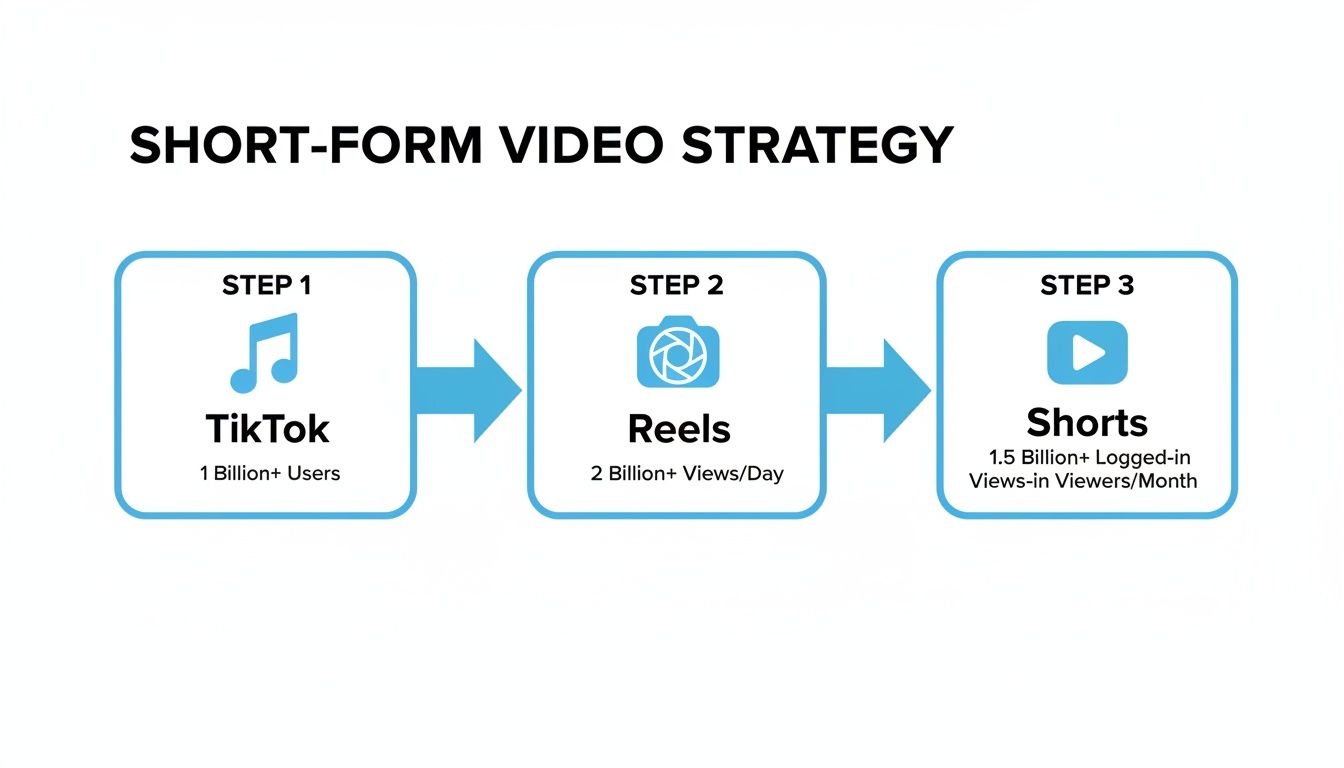
The idea is simple: create once, then distribute across TikTok, Reels, and Shorts to get the most bang for your buck with almost no extra work.
To give you a clearer picture, let's look at a side-by-side comparison of the old, manual grind versus the new, AI-driven workflow.
Traditional vs AI-Powered Video Production
This table breaks down just how much time and effort you save when you let AI handle the heavy lifting. What once took days of specialized work can now be done in minutes.
| Production Step | Traditional Method (Hours/Days) | AI Method with DailyShorts (Minutes) |
|---|---|---|
| Scripting | 2-4 Hours | 1-2 Minutes |
| Voiceover | 1-3 Hours | 1 Minute |
| Video Editing | 4-8 Hours | 2-3 Minutes |
| Adding Captions | 1-2 Hours | Automatic |
| Finding Music | 1 Hour | Automatic |
| Total Time | 1-2 Days | ~5-10 Minutes |
The difference is staggering. AI doesn't just make video creation faster; it makes it accessible, allowing you to focus on strategy instead of getting bogged down in technical details.
Your 10-Minute Path to a Perfect Video
Using a tool like DailyShorts↗, the whole process feels almost effortless. You genuinely don't need any prior video experience to create content that looks like it came from a big-budget agency.
Let’s walk through just how simple it is:
- Input Your Topic: Start with a simple idea, a keyword, or even a link to one of your blog posts. For example, you could just type in "fall skincare tips for dry skin."
- Let AI Do the Heavy Lifting: This is where the magic happens. The AI instantly gets to work, generating an engaging script designed to hook viewers, finding stunning 4K visuals to match the story, and creating a professional voiceover that sounds natural and human.
- Choose Your Visual Style: Now you get to inject your brand's personality. Want a photorealistic look? A cool 3D render? A fun animation? Just pick a style, and the AI handles all the complex rendering work for you.
- Review and Publish: In just a few minutes, your video is ready to go. You can make small tweaks if you want, but the AI-generated draft is usually 90% of the way there. From there, you can publish it directly to your social channels.
The Big Shift: Your job is no longer to figure out how to make a video. Your job is to come up with great ideas. The AI handles the technical stuff, freeing you up to be the expert in your field.
This efficiency isn’t just a nice-to-have; it's a massive competitive advantage. Short-form video now delivers the highest ROI for 41% of marketers, with many calling it their absolute top performer. For small businesses hungry for growth, this is huge—especially since platforms like YouTube Shorts and Reels are rewarding clips that are under two minutes.
By automating the tedious parts of production, you can finally achieve the consistency you need to grow your audience and drive real results. This is how you stop thinking about making videos and start building a powerful video marketing engine for your business. For a deeper dive, check out our guide on how to create AI video↗.
Driving Reach and Proving Your Return on Investment
Look, creating a fantastic video is a huge win. But it's only half the battle.
If you post an amazing video and nobody sees it, did it even happen? This is where smart distribution and measurement come in. It’s the part of the process that turns your creative work into actual business results.
Think of your video like a product you’ve just launched. You wouldn't just stick it on a dusty shelf in the back of the store and hope someone finds it, right? Of course not. You’d put it on a front display, run a promotion, and tell everyone about it. Your video content needs that exact same energy. A solid distribution plan makes sure your videos get in front of the right people at the right time.
This goes way beyond just hitting the “publish” button. It means digging into relevant hashtags to join conversations already happening, figuring out when your audience is actually online, and scheduling your content so you’re always showing up consistently.
Maximize Your Efforts with Content Atomization
One of the most powerful moves a small business can make is Content Atomization. This is just a fancy way of saying you take one big piece of content and chop it up into smaller, snackable pieces to use across all your channels. It’s the ultimate "work smarter, not harder" strategy.
Instead of burning yourself out trying to invent something new for every platform, every single day, you start with one strong, central idea—your "content atom." This could be a longer-form YouTube video, a deep-dive blog post, or even a great customer testimonial.
From that single piece, you can easily spin off a whole week's worth of content. Seriously.
- Five short-form videos: Pull out the most interesting tips or surprising stats and turn them into punchy 30-second clips for TikTok, Reels, and Shorts.
- Three quote graphics: Grab a few powerful lines from your script and design some shareable graphics for Instagram or LinkedIn.
- One carousel post: Break down the main steps or key takeaways into a simple, swipeable carousel for Instagram.
This approach gives your core message the spotlight it deserves without forcing you to constantly reinvent the wheel. You create once and distribute for days.
Measuring What Truly Matters for Business Growth
Likes and views are nice ego boosts, but they don't pay the bills. We call them "vanity metrics" for a reason—they look good on the surface but often don't mean a thing for your actual business growth. To prove your video marketing is actually working, you have to track the key performance indicators (KPIs) that connect directly to your bottom line.
Your goal isn't just to get attention; it's to drive action. The right metrics tell you if your videos are actually persuading people to take the next step with your business.
So, instead of just counting likes, start focusing on these more meaningful numbers:
- Watch Time and Audience Retention: This tells you how long people are really watching. If everyone bails in the first three seconds, you know your hook isn't working. High retention is a dead giveaway that your content is hitting the mark.
- Click-Through Rate (CTR): If you include a link to your website or a product page in your video, the CTR shows you what percentage of viewers actually clicked it. This is a direct line from your video to your website traffic.
- Conversion Rate: This is the big one. It tracks how many viewers took the specific action you wanted them to, whether that’s signing up for your newsletter, booking a call, or buying a product.
And the data backs this up. A staggering 84% of video marketers say video has directly helped them increase sales. For small businesses, it’s even more impactful—an incredible 93% acquire new customers thanks to videos on social media. This proves video isn't just a fluffy branding tool; it's a sales machine. You can discover more insights about video marketing's sales impact on Mavic.ai↗.
By focusing on these action-oriented metrics, you can stop guessing and start making data-backed decisions. You'll finally be able to prove your return on investment and fine-tune your strategy for real, sustainable growth.
Your Video Marketing Questions Answered
Jumping into video marketing can feel a little intimidating. You know it’s important, but a few nagging questions might be holding you back. Let's tackle those common hurdles head-on so you can start making videos with confidence.
Think of this as your quick-start guide to clearing up the confusion. We're going to demystify the process and show you that you already have what it takes to create videos that actually grow your business.
How Much Does Video Marketing Cost for a Small Business?
Let’s get this out of the way first. The days of needing a five-figure budget for a single professional video are long gone. Historically, video production was a massive expense, but today, AI has completely flipped the script, making cost a non-issue for small businesses.
Your biggest investment now is your time—and even that can be slashed to just a few minutes. Tools like DailyShorts↗ have free trials and affordable monthly plans that cost less than a single hour of a freelance videographer's time.
It's a whole new ballgame. With an AI video generator, you can churn out dozens of high-quality, 4K videos for less than you'd pay for one old-school project. This means the real starting cost of video marketing for small business can be next to nothing, only scaling to a small, predictable subscription as you grow.
What Videos Should I Make for a Service-Based Business?
When you don't sell a physical product, what do you show? Simple: you show your expertise. For service-based businesses, video is all about building trust and proving you're the real deal. Your goal is to show potential clients you're the authority who can solve their specific problems.
Instead of product demos, your content needs to deliver pure, undeniable value. Here are four proven ideas that work like a charm for consultants, coaches, agents, and other service pros:
- Educational "How-To" Videos: Share quick, actionable tips. A financial advisor could post a short video on "3 Budgeting Mistakes Almost Everyone Makes." It instantly demonstrates knowledge and genuinely helps the viewer.
- Powerful Client Testimonials: Nothing sells like social proof. A short, authentic clip of a happy client sharing their success story is more convincing than any sales pitch you could ever write.
- Behind-the-Scenes Content: A "day in the life" or a peek into your process humanizes your brand. It builds a personal connection and shows people the real, relatable person behind the business.
- FAQ Video Series: Take your most frequently asked questions and turn them into a library of helpful short videos. This not only saves you time but also positions you as the go-to expert.
How Often Should I Post Videos to See Results?
This is the classic question, but the answer isn't what most people think. Consistency will always beat frequency. It is far better to post one great, value-packed video every week than it is to dump seven sloppy videos in one week and then go silent for a month.
Algorithms on platforms like TikTok↗ and Instagram Reels↗ are designed to reward predictable activity. When you show up consistently, the platforms start to trust your content and begin showing it to more and more people.
A fantastic starting point for any small business is 3-5 short videos per week. That’s an achievable goal that keeps you top-of-mind without burning you out. This is where AI and scheduling tools become your secret weapon, letting you batch-create an entire week's worth of content in an hour and set it to post automatically.
Do I Need to Show My Face on Camera to Be Successful?
Absolutely not. This is one of the biggest myths holding people back. While being on camera can help build a personal connection, some of the most viral accounts out there are completely "faceless."
For introverted entrepreneurs or brands that want the content to be the star, this is where AI tools are a true game-changer. You can use an AI video generator to create incredibly compelling videos without ever hitting the record button on yourself.
Here’s how it works:
- The AI finds high-quality stock footage or generates unique visuals that match your topic.
- It adds dynamic text overlays that tell your story and make key points pop.
- A professional, human-sounding AI voiceover narrates your script with perfect clarity and tone.
This combination lets you produce authoritative and engaging content that builds trust and gets results—all while you stay comfortably behind the scenes.
Ready to stop wondering and start creating? With DailyShorts, you can turn any idea into a viral-ready video in minutes. Let our AI handle the script, visuals, and voiceover, so you can focus on growing your business. Get started for free today on DailyShorts.ai↗.
Ready to create viral videos?
Start creating viral TikTok and YouTube Shorts with DailyShorts AI today.