Launch an automated youtube channel for scalable content and monetization
DailyShorts AI

When you hear "automated YouTube channel," you might picture clunky bots churning out low-quality spam. Let's clear that up right now. A modern automated channel isn't about bots; it's a smart system where AI does the heavy lifting—scripting, video creation, and even scheduling—so you can focus on the big picture.
Think of it as having an AI-driven content engine that produces a steady stream of high-quality videos, all with surprisingly little hands-on effort from you.
Your Blueprint for a Modern Automated YouTube Channel
Forget the old myths. Today's blueprint for an automated channel is all about building a scalable, high-quality content machine designed to win over the YouTube algorithm. This isn't about replacing the creator. It’s about giving you the power to run your channel like a major media company, but without the massive team and budget.
This whole framework is built on a few key ideas:
- Strategic Niche Selection: You pick a topic with a built-in audience and a clear, repeatable format that an AI can easily handle.
- AI-Powered Content Generation: This is the core. You use specialized tools to turn a simple idea into an engaging script, a professional voiceover, and eye-catching visuals.
- Intelligent Scheduling: Let a system handle the publishing, posting your content consistently when your audience is most active to get the biggest impact.
- Data-Driven Optimization: Once the content is live, you watch the analytics to see what's working, then double down on those winning formulas.
Shifting from Manual Labor to Strategic Oversight
The real change here is moving from a hands-on video editor to a high-level creative director. Instead of spending your weekends hunched over editing software, you're now focused on generating powerful ideas, refining AI prompts, and analyzing what your audience responds to. This is where you get real leverage.
The goal isn't to create content with zero effort. It's to redirect your effort toward the high-impact activities that actually grow your channel. Automation takes care of the repetitive grind, freeing you up for strategy, branding, and community building.
For instance, a tool like DailyShorts↗ can take a single topic and spit out a week's worth of publish-ready Shorts. It handles everything—the script, the visuals, the voiceover—turning a process that used to take days into a matter of minutes. That kind of speed is exactly what you need to compete in the fast-paced world of short-form video.
Comparing YouTube Channel Workflows At a Glance
Putting the traditional and automated workflows side-by-side really highlights the difference. The modern approach is built for speed and scale, which are non-negotiable for real, sustainable growth.
This is especially true as YouTube's monetization model evolves. With the creator revenue share hitting 45% in 2025, the platform is rewarding consistent, high-quality output that keeps viewers engaged, not just raw view counts. An automated system is perfectly positioned to deliver just that. You can discover more insights about compliant automation on Postly.ai↗.
| Stage | Manual Approach (Traditional) | Automated Approach (with AI Tools) | Key Benefit |
|---|---|---|---|
| Scripting | Manual writing and research (2-4 hours) | AI-generated from a topic (5 minutes) | Speed & Idea Velocity |
| Visuals | Filming or sourcing stock clips (3-6 hours) | AI-generates 4K visuals automatically | Cost & Time Savings |
| Editing | Manual editing and syncing (4-8 hours) | AI edits and syncs media in minutes | Massive Efficiency Gain |
| Scheduling | Manual upload and optimization per video | Auto-posts and optimizes 24/7 | Strategic Consistency |
Ultimately, the choice comes down to what you're trying to achieve. If you want to build a content empire without burning out, automation isn't just an option—it's the only path forward.
Comparing Manual vs. AI-Powered Content Workflows
Deciding how you'll create your content is easily the biggest fork in the road you'll face when building an automated YouTube channel. This isn't just about picking "easy" versus "hard." It's a strategic call that will define your channel's speed, scale, and creative ceiling. The best workflow for you comes down to your goals, your resources, and the kind of videos you actually want to make.
Forget a generic pro/con list. Let's dig into a real-world situational analysis. We’ll pit the traditional, hands-on manual workflow against a modern, AI-driven system to help you figure out which path truly aligns with your vision. It’s not about which one is better overall, but which one is better for you.
The Core Tradeoff: Speed vs. Granular Control
When you get right down to it, the difference between these two approaches is a single, fundamental trade-off. Manual creation gives you absolute, frame-by-frame control over every last detail. An AI workflow, on the other hand, delivers production speed that would have been unimaginable just a few years ago.
Picture a solo creator trying to run a "Daily Historical Facts" Shorts channel. Doing it manually, they'd spend hours every single day scripting, digging up archival footage, recording a voiceover, and painstakingly editing a 60-second video. It’s a meticulous process that guarantees every detail is perfect, but it also puts a hard cap on their output.
Now, imagine that same creator using an AI-powered system. They could generate a full week's worth of scripts in minutes. They could have an AI pull together relevant visuals and produce a professional voiceover automatically. The time savings are massive—we're talking about generating seven videos in the time it takes to manually produce one. This kind of speed is the engine that drives a successful automated channel.
This decision tree helps visualize the choice based on what you’re trying to achieve.
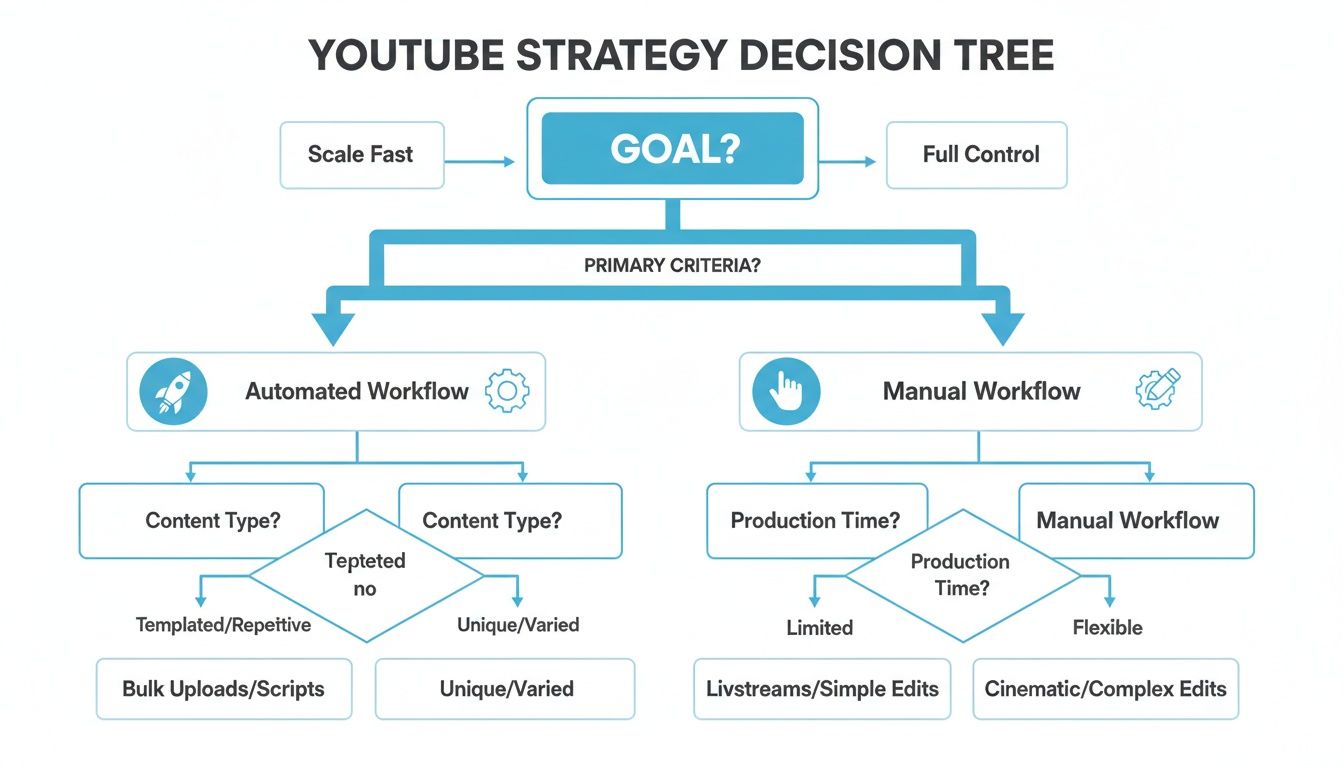
As you can see, if rapid scaling and a relentless posting schedule are your game plan, an automated workflow is the obvious choice. If total creative command is non-negotiable, then sticking with a manual approach makes more sense.
Situational Workflow Analysis
Let's break down how these workflows hold up in a couple of common scenarios, looking at them through the lens of cost, scalability, and creative oversight.
Scenario 1: The Solo Creator Launching a Niche Channel
- Manual Approach: You have to be the writer, editor, strategist—everything. Your main cost is time, and it's a huge one. Trying to scale is a fast track to burnout, limiting you to maybe a few uploads per week. You have total control, but the workload is crushing.
- AI-Powered Approach: You shift from being an editor to a producer, guiding the AI. The cost moves from your time to a reasonable software subscription. This setup makes daily uploads possible right from the start, which is a massive advantage for pleasing the YouTube Shorts algorithm. You still set the creative direction with prompts and templates, maintaining strategic control without getting lost in the weeds of editing.
Scenario 2: The Agency Managing Multiple Client Channels
- Manual Approach: This model demands a big team—editors, scriptwriters, voice artists—which means high overhead and messy project management. Keeping quality consistent across different channels becomes a real headache, and bringing on new clients is a slow, expensive process.
- AI-Powered Approach: A small, agile team can suddenly manage a whole portfolio of channels. The workflow gets standardized, which means you can guarantee consistent quality and branding for every single client. The agency can scale its operations incredibly fast, adding new channels without having to hire more people. It’s simply a much more profitable way to run the business.
The key differentiator is leverage. A manual workflow directly ties your output to the hours you put in. An AI-powered workflow completely decouples them, letting you multiply your creative output without multiplying your effort.
In the end, it all comes down to your ambition. If you're serious about building a truly automated YouTube channel that can grow month after month, the AI-powered workflow isn't just an option; it's a necessity. It gives you the speed and consistency you need to compete and build a content engine that works for you 24/7.
If you want to see exactly how the tools work, you can get a closer look at how to create an AI video with advanced tools↗.
Building Your AI Content Pipeline Step by Step
Alright, let's move from theory to action. This is where the magic of an automated YouTube channel really comes to life. Building an AI content pipeline is all about creating a reliable, repeatable system that takes a simple idea and turns it into a finished video, almost entirely on its own. Let’s break down exactly how to build this production line using an AI video generator like DailyShorts.
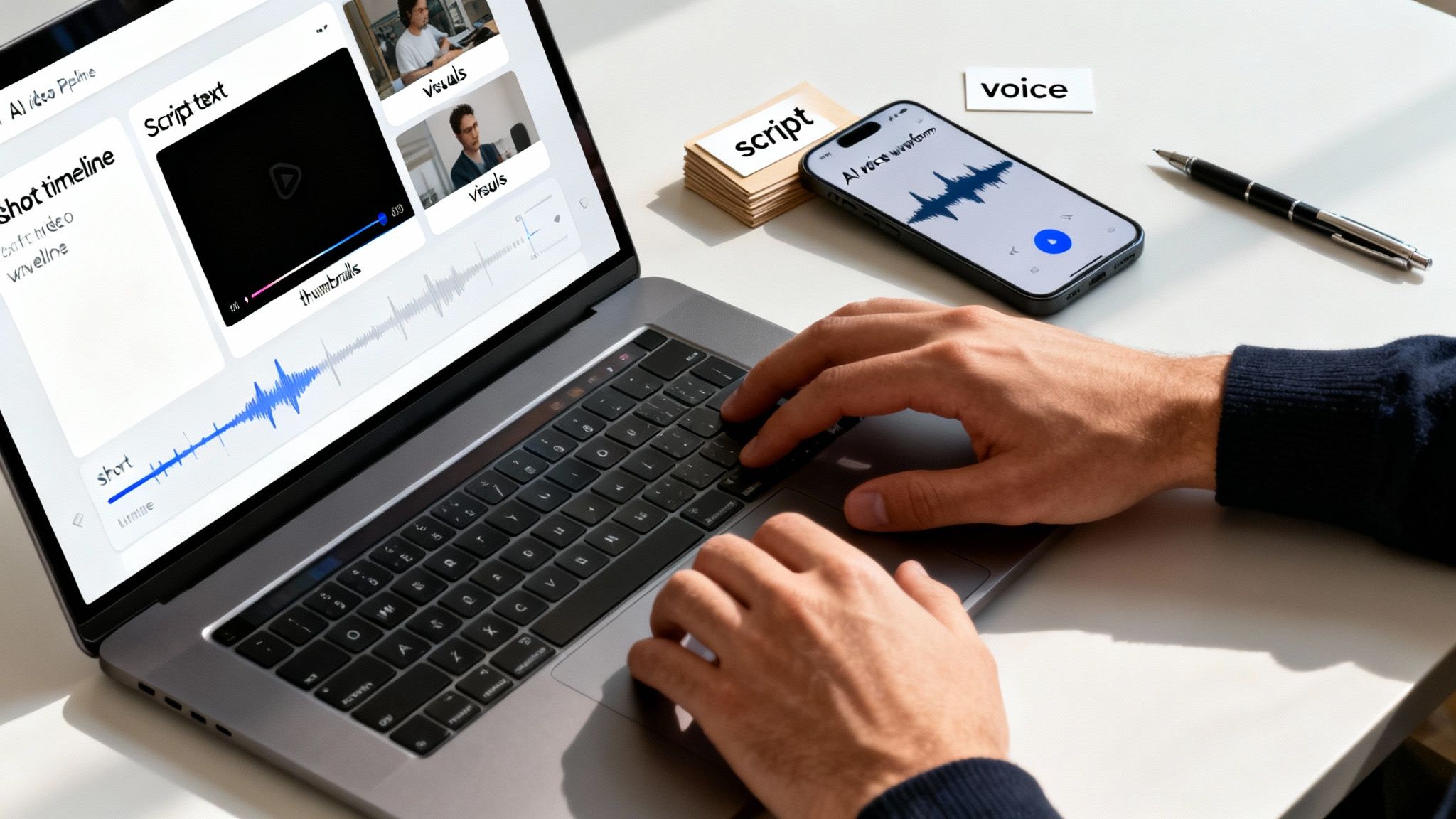
The whole thing kicks off with a single, powerful input: your topic. It could be "surprising facts about the Roman Empire" for a history channel or "three beginner investing mistakes" for a finance niche. Once you provide that spark, the AI takes the wheel.
From Prompt to Polished Script
Your first stop is scripting. Instead of battling a blinking cursor on a blank page, you just feed your topic to the AI. The system then spits out a script that’s already optimized for short-form video—we're talking a strong hook, quick-fire points, and a punchy call to action.
For instance, a prompt like "fascinating deep-sea creatures" might produce a script that starts with a killer question, introduces three bizarre animals with captivating details, and wraps up by asking viewers to drop their favorite in the comments. This structure is engineered for high retention right from the get-go. To see this in more detail, check out our guide on turning a script into a high-impact video↗.
Generating High-Retention Visuals
With the script locked in, the AI gets to work on the visuals. Honestly, this is where modern tools are just incredible. Forget spending hours digging through stock footage libraries. The AI automatically generates or pulls high-quality 4K visuals that perfectly match the script, scene by scene.
- For a history short: It could conjure up images of ancient maps, marching Roman legions, and crumbling aqueducts.
- For a finance video: You might get visuals of soaring stock charts, overflowing piggy banks, and anxious-looking investors.
A game-changing feature here is image-to-video animation. The AI can take a static, generated image—say, a portrait of a stoic philosopher—and add subtle motion like a slow zoom or a gentle pan. That tiny bit of movement is absolutely essential for keeping eyes glued to the screen on platforms like YouTube Shorts, where a static image is the fastest way to get swiped.
The real beauty of this pipeline isn't just the speed; it's the brand consistency. By locking in style presets—like '3D Render' or 'Cinematic'—you ensure every single video has a cohesive, professional feel that builds your channel's identity.
Adding Professional Voice and Sound
The final touches are all about audio. A powerful text-to-speech engine transforms your script into a surprisingly natural-sounding AI voiceover. You can pick from a whole range of voices and emotional tones to fit your brand, whether you need a high-energy narrator for a listicle or a more serious tone for a historical deep-dive.
At the same time, the system layers in background music and sound effects that pump up the story without being distracting. The final product? A fully produced video with engaging visuals, professional narration, and an immersive soundscape—all put together in a matter of minutes.
This isn't just a novelty; it's quickly becoming the standard. Over 42% of creators are already using AI for everything from scene generation to voice cloning. In a world where content volume is king, that kind of efficiency is what separates the winners from the rest.
By following these steps, you’re not just making videos; you’re building an assembly line for your automated YouTube channel. You feed ideas in one end, and a steady stream of high-quality, algorithm-friendly videos flows out the other, ready to be scheduled and unleashed on the world.
Getting Your Content Seen: Smart Scheduling and Optimization
Look, making great videos is just step one. The real challenge? Getting those videos in front of the right eyeballs at the exact moment they're ready to watch. This is where an automated YouTube channel truly leaves the competition in the dust. We're moving past just making content and into building a powerful distribution engine that turns your video queue into a nonstop stream of views and new subscribers.
Let's break down the difference between the old-school, manual way of uploading and a modern, fully automated system. The gap between them is massive, and it's about more than just convenience. It affects your channel's growth, how well you rank in search, and your ability to scale. It’s like the difference between hand-delivering flyers one by one versus launching a targeted digital ad campaign to millions.
The Old Way: The Manual Grind
Think about what it takes to upload a video by hand. You finish the edit, and then the real work starts. You have to dig through keywords, craft the perfect title, write a description that pulls people in, pick the right tags, design a thumbnail, and then try to guess the best time to hit "Publish." This isn't a one-and-done job; it's a soul-crushing routine you repeat for every single video.
Now, imagine a different way. With an integrated system like the Auto Pilot mode in DailyShorts↗, you just drop your entire batch of videos into the queue. That's it. The system takes the wheel from there, scheduling and publishing your content 24/7, all based on hard data about when your audience is most likely to be online and watching.
This is a fundamental shift from being reactive to being strategic. Manual posting usually means you upload whenever you can find a spare moment. An automated system posts when your audience is ready, giving every video a powerful launchpad with the algorithm.
This isn't about saving a few minutes here and there. It’s about completely changing how you manage your channel. You can knock out weeks' worth of content in one sitting and then let the system handle the daily grind, freeing you up to think about the bigger picture—your next big idea or new content angles.
Optimizing for the Algorithm on Autopilot
Real automation is more than just a glorified calendar. A truly smart system digs into the nitty-gritty of YouTube SEO for every video it posts. A human might take a good guess at the best tags or title, but an automated optimizer crunches trend data and performance metrics to make decisions that actually work.
Here’s what that looks like in practice:
- Bulk Upload: You drop a batch of 20 videos on "surprising historical facts" into your scheduler.
- Smart Timing: The system scans your channel's analytics and automatically slots the videos into your peak viewership windows—maybe that’s 3 PM on weekdays and 11 AM on weekends.
- Dynamic SEO: For each individual video, the Auto Pilot generates a few different title options, pulls in relevant, high-traffic tags based on what people are searching for right now, and writes a description packed with keywords. It's like having an SEO pro personally optimize every upload.
- Hands-Off Publishing: The system just keeps on posting, day in and day out, with zero input from you. Your channel stays active, consistent, and in the good graces of the YouTube algorithm.
This methodical approach gives you a serious leg up. For social media pros managing video campaigns, using API-compliant tools for scheduling is a game-changer. It helps dodge 65% of the restrictions that trip up non-compliant bots, keeping your channel safe for the long haul. You can learn more about scaling your video content the right way.
By automating not just when you post but also how you optimize, you give every single video its best shot at taking off. You stop throwing content at the wall and hoping something sticks. Instead, you’re using a data-driven system to launch each video with surgical precision, fueling the relentless growth of your automated YouTube channel.
Keeping Your Automated Channel Safe and Thriving
Building an automated YouTube channel is thrilling. The speed and scale are incredible, but true long-term success comes down to smart oversight. If you just set up an AI pipeline and walk away, you’re setting yourself up for failure. To build a channel that’s not just big, but also resilient and safe from YouTube's wrath, you have to bake sustainability and compliance in from the start.
This means you can't just "set it and forget it." Think of yourself as the captain of a powerful content-creation ship. Your job is to steer it, making sure everything it produces is high-quality, original, and plays by YouTube's rules. Otherwise, you'll end up with a channel full of generic junk that both the algorithm and real people will eventually tune out.
Staying Clear of Copyright and AI Policy Traps
One of the biggest landmines in automation is accidentally stepping on a copyright. AI tools are amazing at creating visuals, but they don't exist in a legal bubble. You absolutely must use platforms that pull from licensed media libraries or create genuinely new images. This ensures you have the commercial rights to every single frame in your videos.
YouTube's own policies on AI-generated content are also a huge deal. The platform now requires you to disclose when your videos use realistic "altered or synthetic media." This isn't a punishment; it's about being transparent with your audience. Forgetting to check that box can get your videos taken down or even your entire channel suspended.
The rule of thumb is simple: use automation to help you create, not to impersonate or deceive. YouTube still wants a human guiding the creative vision, making sure the end result offers real value instead of just being spammy AI garbage.
The Problem with "AI Slop"
If you're not careful, an automated channel can quickly start pumping out what people are calling "AI slop." This is content that looks technically fine but feels completely soulless. It has no spark, no originality, and no unique point of view. It's a one-way ticket to boring your audience and getting buried by the algorithm.
The only way to avoid this fate is to have a strict quality control process.
- Always Have a Final Review: Never let a video go live without a human giving it a final once-over. This is your last chance to catch weird phrasing, out-of-place visuals, or glaring factual mistakes.
- Master Your Prompts: Your AI prompts are your creative briefs. Get super specific about the tone, style, and exact points you want the AI to hit. The better the input, the better the output.
- Develop Your Own Style: Create unique content templates and brand guidelines. This is how you give your videos a consistent look and feel that helps you stand out from the sea of other automated channels.
Building an Operation That Lasts
At the end of the day, you're trying to build a real asset, not a ticking time bomb. A compliant, quality-focused automated channel is built to last. The difference in results is night and day. We've seen tech channels using proper, compliant automation for their scheduling explode to 100,000 subscribers. On the flip side, channels that cut corners with non-compliant bots often face 20% revenue losses after getting hit with demonetization. You can read the full analysis of scaling compliantly on Postly.ai.
Putting these safeguards in place isn't about slowing yourself down—it's about protecting your investment. You're building a sustainable YouTube machine that can roll with platform changes, keep your audience engaged, and grow steadily for years to come.
Using Analytics to Scale Your Automated Strategy
An automated YouTube channel isn't just a "set it and forget it" machine. It’s an engine, and like any engine, it needs fuel. That fuel is data. Launching your content is just the first step; the real secret to explosive growth is figuring out what your audience loves and then giving them more of it. This is where YouTube Analytics↗ becomes your command center, turning raw numbers into a clear roadmap for scaling your entire operation.
Forget getting bogged down by vanity metrics like total view counts. For an automated channel, especially one focused on Shorts, the numbers that truly matter are the ones that measure viewer commitment. Your mission is to build a feedback loop where performance data directly informs your next batch of AI prompts, constantly sharpening your content for maximum impact.
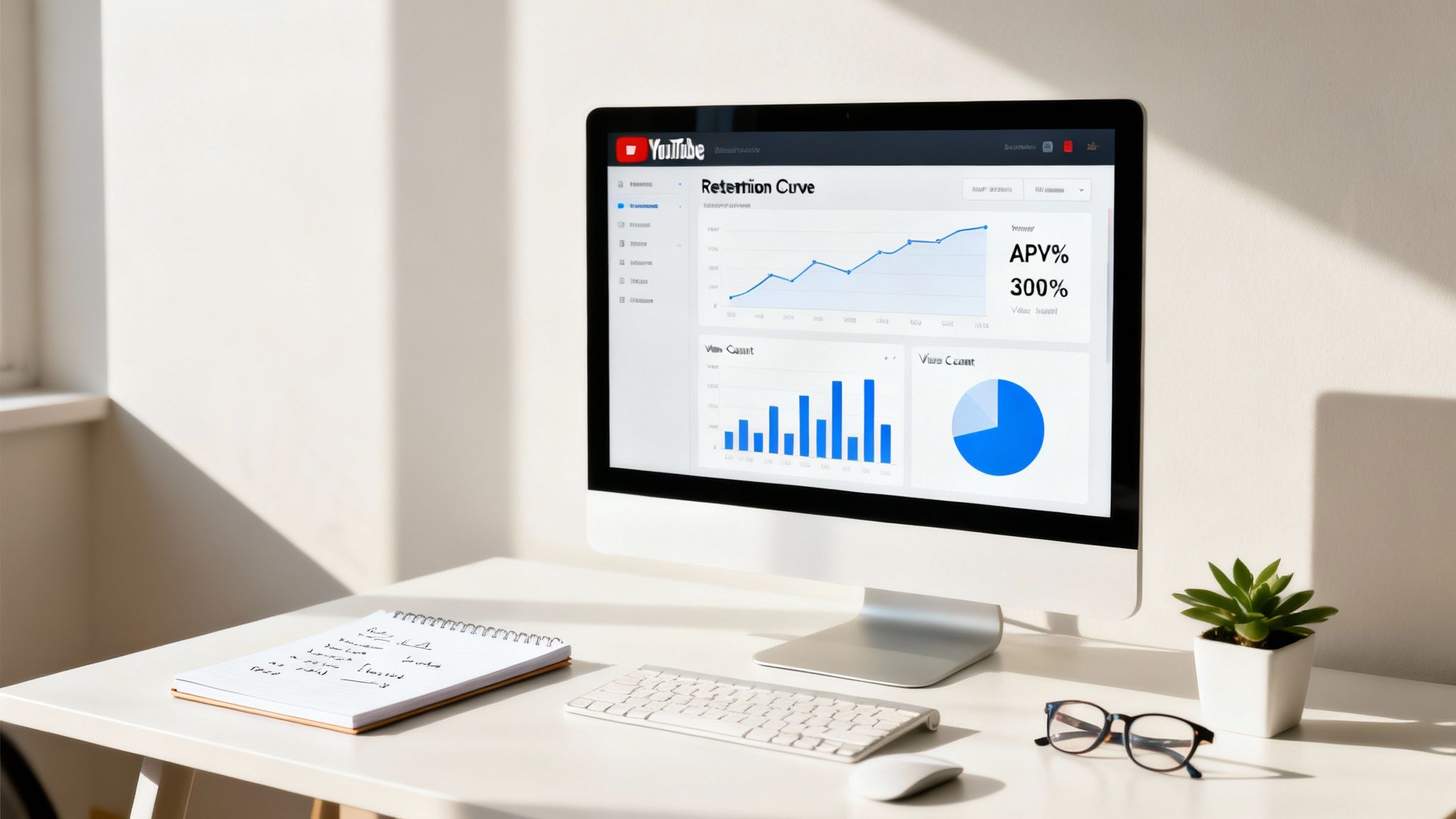
Identifying Your Winning Content Formulas
First things first: you need to dive into your analytics and find your home-run videos. But don't just sort by "most views." You need to look deeper, focusing on the metrics that signal real engagement and tell the YouTube algorithm that your stuff is worth pushing to a much wider audience.
These are the key performance indicators (KPIs) you should be obsessing over:
- Average Percentage Viewed (APV): This is your holy grail. A high APV means people are hooked and watching nearly to the end. For Shorts, anything north of 90% is a fantastic sign that you've found a winning formula.
- Audience Retention: Go beyond the average and look at the retention graph for individual videos. Pinpoint exactly where viewers are dropping off. This tells you which hooks are landing and which parts of your script are causing people to swipe away.
- Views-to-Subscriber Conversion: This one is gold. It shows you which videos were so compelling that they turned a complete stranger into a subscriber. Any video with a high conversion rate is a blueprint you need to study.
The YouTube Shorts algorithm has gotten incredibly smart about rewarding these exact signals. It’s no longer a mystery. Top-performing Shorts are now hitting an insane 98% average percentage viewed, with swipe-away rates as low as 25%. This is the kind of engagement that can launch a single video past 220,000 views and reel in hundreds of new subscribers. You can always explore more about the Shorts algorithm on YouTube to stay ahead of the curve.
Turning Insights Into Actionable AI Prompts
Once you've identified your winners, it's time to play detective and reverse-engineer their success. This is how you close that feedback loop and make your automated channel smarter with every single upload.
Let's imagine your best video was "3 Unbelievable Facts About Ancient Rome," and it crushed it with a 95% APV. Now you have to break down why it worked so well.
- The Hook: Did it open with a bold, provocative question?
- The Pacing: Was the information delivered in punchy, 5-second clips?
- The Visuals: Did you use a specific AI art style, like "cinematic realism," that really connected with viewers?
Now for the magic. You take these findings and translate them directly into a new and improved AI prompt or content template.
Old Prompt: "Create a video about interesting history facts." New, Data-Driven Prompt: "Generate a 55-second script with a question-based hook about a surprising historical event. Structure it into three quick facts, each revealed with cinematic-style visuals and a dramatic voiceover. End with a call to comment on the most shocking fact."
This refined process takes the guesswork out of content creation. You're no longer just throwing things at the wall to see what sticks. Instead, you're systematically doubling down on what's proven to work, using hard data to steer your AI. By making analytics the heart of your strategy, you transform your automated channel from a simple content machine into an intelligent, self-improving growth engine.
Got Questions? We've Got Answers
Stepping into YouTube automation for the first time? You probably have a few questions. Let's tackle the big ones so you can move forward with confidence.
Can You Actually Monetize an Automated YouTube Channel?
Yes, you absolutely can. The big misconception is that "automated" means "low-effort" or "spammy," but that's not the goal here. YouTube doesn't care if you used AI to help create your videos; it cares about the final product.
As long as your content is original, valuable to your audience, and follows the YouTube Partner Program guidelines, you're in the clear. Think of automation as your production team, not a magic button for churning out junk. The human element—your strategy, creativity, and quality control—is what makes it work.
How Do You Keep AI-Generated Content from Looking... Well, AI-Generated?
This is the most important part of the whole operation. If your videos scream "robot," you'll never build an audience. Quality control is everything.
Here’s how we keep the quality high:
- Master Your Prompts: Don't just give the AI a topic. Give it a character, a tone, a visual style, and specific instructions. A detailed prompt is the difference between a generic video and a great one.
- Implement a "Final Eyes" Check: Never, ever post a video without watching it yourself. This is your last chance to spot weird visuals, clunky sentences, or anything that just feels off.
- Build Your Own Templates: Don't rely on the default settings. Create your own unique video formats and visual styles. This gives your channel a consistent look and feel that helps you stand out.
The real aim isn't just to automate. It's to build a system that reliably produces quality content. Your job is to be the director, guiding the tools to create something you're proud of.
What's the Best Niche to Start With?
The sweet spot is a niche with tons of audience interest where the content can be structured into a repeatable format. Evergreen topics are gold because a video you make today can still be pulling in views years from now.
Some niches that are practically built for this model include:
- Fascinating Facts & History: Think bite-sized explainers on historical events, scientific breakthroughs, or psychological concepts.
- Top 10 Lists: This format is a proven winner. You can rank anything from luxury cars to historical blunders.
- Motivational Content: People are always searching for inspiration. Compiling and visualizing famous quotes or short speeches works incredibly well.
The best advice? Pick a topic you actually know something about. Your own knowledge is the secret ingredient that will help you guide the AI to create content that feels authentic and truly connects with viewers.
Ready to stop just thinking about it and actually build your AI-powered content engine? With DailyShorts, you can turn a simple idea into a finished video in minutes. Join over 50,000 creators who are already building their automated channels. Get started today at https://dailyshorts.ai↗.
Ready to create viral videos?
Start creating viral TikTok and YouTube Shorts with DailyShorts AI today.