How to Make Short Videos That Go Viral in 2026
DailyShorts AI
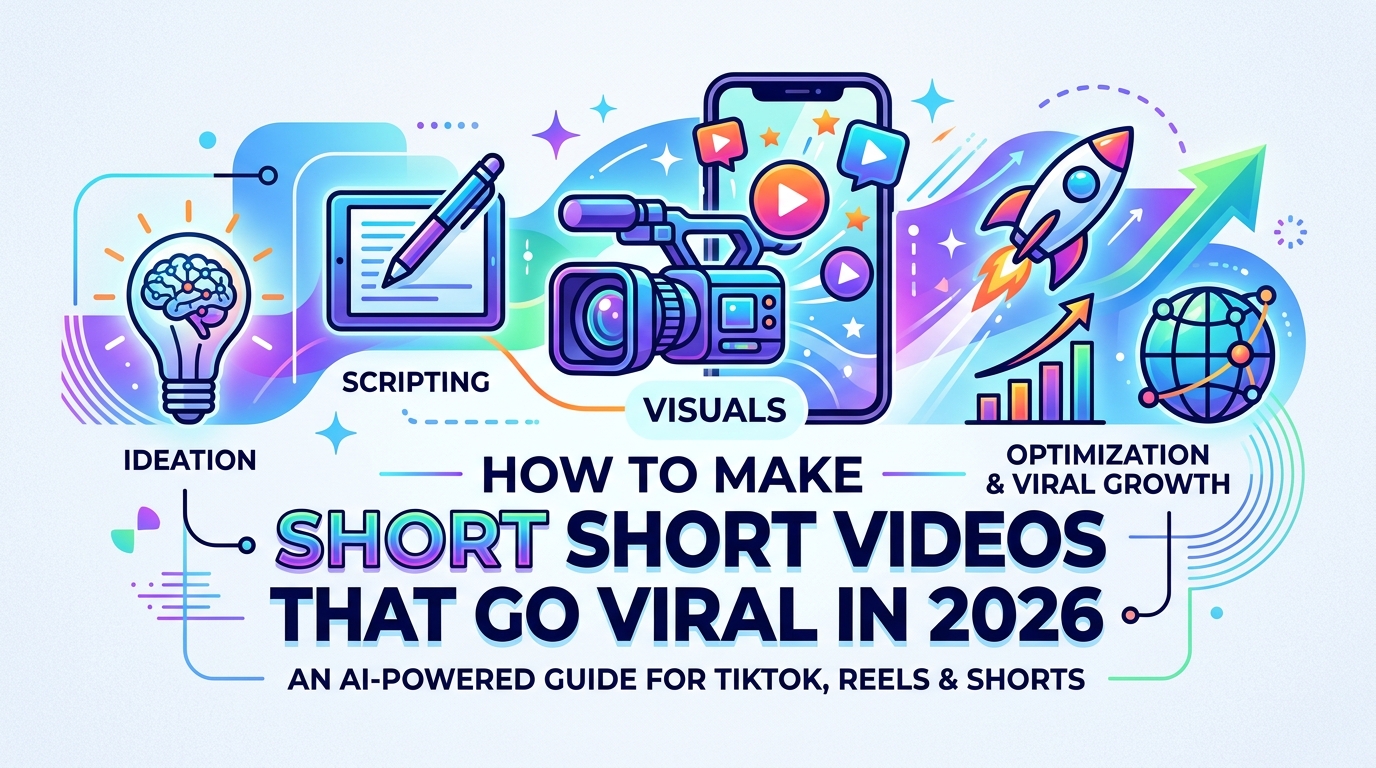
Short-form video isn’t a side project anymore. By 2024, 71% of companies produced at least some of their marketing videos internally, up from 63% in 2023, and 91% of businesses use video as a marketing tool. The category itself is also expanding fast, with global short-video platforms projected to grow from USD 53.48 billion in 2025 to USD 106.22 billion by 2032 according to this short-form video statistics roundup↗.
That changes the core question behind “how to make short videos.” It’s not how to make one decent clip when you have a free afternoon. It’s how to build a system that can turn rough ideas into publishable videos without burning hours on scripting, sourcing visuals, editing, exporting, resizing, captioning, and posting.
Most creators still use a broken workflow. Notes app for ideas. One tool for script drafting. Another for voiceover. Another for editing. Another for captions. Then the upload grind starts. That process works once in a while. It does not hold up when you need consistency.
The End of Slow and Frustrating Video Production
Short-form volume is brutal, and speed is no longer optional. The creators who publish consistently are not squeezing more hours out of the day. They are removing handoffs, duplicate work, and tool switching from the process.
Many creators still rely on a fragmented workflow. Ideas live in notes. Scripts happen in one app. Voiceovers happen in another. Editing happens somewhere else. Then captions, exports, resizing, and scheduling pile on. I have run that setup before. It turns a 30-second video into an afternoon of low-value production work.
Slow production often stems from pipeline issues rather than a lack of creativity. The delays usually come from the same places:
- Script drift. The idea is fine, but the opening keeps getting rewritten because there is no fast way to test different hooks.
- Asset hunting. Time disappears into finding footage, screenshots, background clips, and music that match the script.
- Edit bloat. A simple cut becomes ten rounds of tweaking because pacing, captions, voice, and visuals were built in separate steps.
- Publishing drag. Different aspect ratios, caption formats, file names, and upload steps create friction right at the finish line.
This is why an AI-first workflow matters. DailyShorts collapses ideation, scripting, visuals, voice, editing, and publishing into one connected system, so the job stops feeling like a relay race between tabs. Instead of managing exports and handoffs, you move one concept through a single production line and get to a publishable video much faster.
That does not mean every creator should stop recording original footage. Gameplay, tutorials, and reaction content still benefit from raw inputs you capture yourself. If that is your format, keep recording simple with free recording tools for gamers↗ and feed the footage into a tighter short-form workflow afterward.
Operational drag hits teams too. Approvals stall. Assets get lost in chat threads. Drafts pile up with no clear owner or next step. A documented system for video production project management↗ cuts that waste before it reaches the edit.
The shift is bigger than a few productivity tips. It is a new operating system for making short videos. One pipeline in. Finished clips out. That is how creators go from scattered ideas to viral-ready output without spending the day assembling the same video by hand.
Crafting the Perfect Script Before You Hit Record
Most short videos fail before recording starts. The problem isn’t effort. It’s structure.
Existing advice usually stops at “keep it short” or “start with a hook.” That’s incomplete. Script pacing changes across TikTok, Reels, and Shorts, and creators rarely get practical guidance on why structure matters. There’s also a search angle now. 40% of Gen Z uses TikTok as a search engine rather than Google, which means the words in your opening lines affect discovery as much as retention, as noted in Jon Loomer’s lessons from short-form creation↗.

Use a three-part script that fits the feed
A short video script needs three jobs, in this order:
-
Hook
The opening has to create a reason to stay. Don’t open with greetings, context dumps, or branding. Open with tension, contrast, a claim, a mistake, or a visual promise.
-
Body
Most creators tend to over-explain. The body should move in clean beats. One idea per sentence. One payoff per beat. If a line doesn’t move the viewer toward the result, cut it.
-
CTA
Most calls to action fail because they’re disconnected from the content. The CTA should feel like the next obvious step. Watch the full breakdown. Try the method. Save this. Comment with your version.
What good hooks actually do
Hooks aren’t just “interesting openings.” They perform one of a few specific functions:
- They interrupt expectation with a surprising claim or visual.
- They create an information gap by showing a result before the explanation.
- They frame relevance fast so the viewer knows the topic applies to them.
- They imply speed by suggesting a quick payoff.
Practical rule: If your first line needs a second line to become interesting, it’s not a hook.
This is also why AI-assisted scripting is useful when it’s done well. A tool should not spit out generic hype. It should generate a script with a strong first line, tight body pacing, and a CTA that fits the platform. DailyShorts handles that kind of script-to-video workflow↗ by turning a topic into a platform-aware draft you can refine instead of writing from zero.
A simple draft formula that works
Try this when you’re staring at a blank page:
| Script part | What to write | Common mistake |
|---|---|---|
| Hook | Start with the problem, result, or contradiction | Long intros |
| Body beat 1 | Name the mistake or tension | Too much background |
| Body beat 2 | Show the fix or method | Listing everything |
| CTA | Point to one next action | Generic “follow for more” |
The goal isn’t to sound polished. It’s to sound clear under speed. Short videos don’t reward elegant setup. They reward immediate usefulness.
If you want a script test, read it out loud once. If you run out of breath, the viewer ran out of patience earlier.
Create Breathtaking Visuals Without a Camera Crew
The biggest lie in short-form is that you need a setup before you can make something worth watching. You don’t need a camera crew, a location, a lens kit, or a stock subscription to build strong visuals for vertical video anymore.
What you need is visual intent. The scene has to match the script’s promise.

Stop thinking in footage, start thinking in scenes
Most weak shorts look weak because the creator is filling time with random clips. A better approach is to decide what the viewer should see at each beat.
If the script says “your content pipeline is broken,” don’t cut to a vague laptop montage. Show overload. Messy tabs. Chaotic timelines. A visual bottleneck. If the script says “AI can turn one idea into a finished short,” show transformation, not talking heads.
That’s where AI-generated visuals become practical, not gimmicky. You can create a sci-fi backdrop for a trend explainer, a clean 3D render for a product concept, or a stylized character scene when on-camera footage would dilute the message.
When generated visuals work best
AI visuals are strongest in a few situations:
- Abstract topics like productivity, systems, marketing, or psychology.
- Early-stage ideas when you want to test an angle before filming anything.
- Brand consistency when your feed needs a recognizable look.
- Repurposing when you have a script but no matching footage.
They’re weaker when authenticity is the whole point. If you’re reviewing a physical product, showing a client process, or reacting to a live event, original footage usually carries more trust. The trade-off is simple. Generated visuals win on speed and style control. Real footage wins when proof matters more than polish.
Don’t ask whether a visual is “AI” or “real.” Ask whether it strengthens the promise of the line it supports.
For creators working from family archives, old screenshots, or a single strong image, animation can also do a lot of heavy lifting. If you want examples of how people make video from a treasured photo↗, that workflow is useful because it shows how a still image can become motion instead of filler.
Motion matters more than complexity
A short video doesn’t need cinematic spectacle. It needs movement that gives the eye something to follow. Subtle camera drift, layered depth, animated text, and image-to-video motion often outperform cluttered edits because the viewer can process them quickly.
This kind of demo makes the point better than a paragraph:
If you’re comparing tools, focus less on “AI magic” and more on output control. The useful platforms are the ones that let you generate vertical scenes in distinct styles, keep visual consistency across clips, and animate still assets without forcing a full manual edit. That’s the standard to use when reviewing AI video generators for short-form content↗.
A good short doesn’t need expensive footage. It needs visuals that arrive on cue, support the line, and keep the viewer from swiping.
Mastering Pace with AI Voice and Automated Editing
Pacing decides whether a short gets watched or abandoned. Not editing flair. Not transitions by themselves. Pace.
The reason is simple. The average human attention span online is about 8 seconds, and short-form feeds compress that even further. Platform algorithms also reward completion rate, and stronger completion leads to wider distribution. The same research notes that even 5% to 10% completion rate increases can lead to stronger algorithmic amplification, especially when the content builds curiosity or emotion, according to this analysis of short-form storytelling and retention↗.

Voice is pacing, not decoration
A lot of creators still treat voiceover as a separate layer. It isn’t. The voice defines tempo.
If the read is too slow, the edit has to overcompensate with frantic cutting. If the read is too stiff, the captions and visuals can’t save it. Good AI voice tools matter because they let you control speed, pause placement, emphasis, and tone without rerecording ten versions.
Here’s what usually works:
- Short sentences keep momentum stable.
- Intentional pauses give the viewer time to process a claim.
- Stress on key words creates rhythm without sounding theatrical.
- Natural variation prevents the robotic flatline that kills retention.
Editing should follow the sentence, not the timeline
Creators often edit by feel. That’s fine when you have time. It’s a bad system when you need output every day.
A stronger method is to let the script and voice dictate the cuts. Every sentence creates an edit cue. Every beat shift justifies a visual change. Every payoff gets a stronger frame than the setup before it. Once you work this way, automated editing stops feeling lazy and starts feeling precise.
A practical pacing stack looks like this:
| Element | What it should do |
|---|---|
| Opening frame | Stop the scroll immediately |
| Voiceover | Set the rhythm of the entire short |
| Captions | Reinforce key phrases, not every breath |
| Visual cuts | Land on meaning changes |
| End beat | Resolve or loop cleanly |
The cleanest short usually feels faster than it is because nothing in it is waiting around.
That’s also why dynamic captions matter. They aren’t there to decorate the screen. They act as timing anchors. A few emphasized words, timed well, can pull attention back when the viewer is drifting.
What to measure after publishing
If you want better pacing, stop obsessing over surface-level polish and review these signals instead:
- Completion rate tells you whether the rhythm held up.
- Shares and saves show whether the content felt worth keeping.
- Comments per view can reveal whether the idea triggered response, not just passive watching.
The production shortcut is that AI can now connect these layers. Script, voice, captions, cuts, and scene timing can be coordinated in one pass instead of patched together manually. That’s the core value of automatic content creation workflows↗. They reduce editing labor, yet their greatest contribution is reducing timing errors.
When pacing is right, the video feels inevitable. The next line arrives when the viewer wants it. The next visual lands before attention slips. That’s what keeps people watching to the end.
Automate Your Growth Across TikTok, Reels, and Shorts
Making the video is only half the job. Distribution is where a lot of good content dies.
Short-form audiences behave in repeatable ways. Videos under 90 seconds retain roughly 50% of viewers, 73% of users watch short-form video multiple times per day, and 81% consume it on smartphones in vertical format. The opening matters because 71% of viewers decide within the first few seconds whether to keep watching, based on this short-form audience behavior report↗.
That gives you a clear publishing standard. Keep it mobile-first. Keep it vertical. Make the first moments unmistakable.
Short-Form Video Platform Specifications 2026
| Specification | TikTok | Instagram Reels | YouTube Shorts |
|---|---|---|---|
| Primary format | Vertical video | Vertical video | Vertical video |
| Best use case | Trend speed, fast testing, search-style discovery | Brand presentation, lifestyle, creator consistency | Discovery, repurposing, audience growth around channels |
| Opening style | Fast, direct, curiosity-heavy | Clean visual hook, polished first frame | Immediate topic framing, clear promise |
| Caption style | On-screen text can be more aggressive | Cleaner visual presentation usually helps | Strong topic clarity helps with discovery |
| Editing tolerance | Raw cuts often work | Slightly more polished pacing usually fits | Clear structure and quick delivery work well |
| Content role | Attention and testing | Brand reinforcement and reach | Discovery that can route to deeper content |
That table isn’t about hard platform rules. It’s about creative fit. The same script rarely performs the same way everywhere without adjustment.
Build a posting engine, not a posting habit
Creators who upload manually tend to disappear when life gets busy. Consistency dies first. Then learning dies with it because there’s no feedback loop.
A content engine fixes that by standardizing the work:
- Batch inputs so one idea can become multiple clips.
- Schedule distribution instead of posting when you remember.
- Adapt metadata for each platform rather than copying the same text everywhere.
- Review outcomes weekly so future scripts improve.
If you need topic prompts, angle starters, or packaging ideas, this list of YouTube Shorts ideas for growth↗ is useful because it helps break the “what do I post today?” cycle that stalls momentum.
The key shift is automation. A tool like DailyShorts can run this through social media automation software↗, including scheduling and platform-specific optimization, so the creator isn’t trapped in the daily upload routine.
Consistency is rarely a motivation problem. Usually, the system asks for too many manual decisions.
The more channels you run, the more that matters. A creator with one account can brute-force posting for a while. A brand, agency, or educator can’t. They need a workflow that keeps publishing even when they’re focused on the next idea, not the next export screen.
Your Path to Becoming a Prolific Video Creator
The old way to make short videos was fragmented. Think of an idea, fight the script, scramble for visuals, patch together the edit, then remember to post it. That process trained creators to believe volume required sacrifice. Less quality, less sleep, or both.
That trade-off is getting weaker. The modern workflow is tighter. One input becomes a script, visuals, voiceover, edit, and scheduled post inside the same operating system. That doesn’t remove judgment. It removes production drag.
Prolific creators work like operators
The biggest difference between occasional creators and prolific ones isn’t inspiration. It’s throughput with standards.
They know three things:
- One good idea can become several short angles
- Publishing needs a system, not willpower
- Short-form should feed a deeper content stack
That last point is more significant than commonly acknowledged. Short videos are powerful for discovery, but they’re weak if you expect them to do all the trust-building by themselves. Research on short-form strategy found that brands do better when short videos act as discovery engines for longer content, and that integrated strategies combining both formats can produce 8% to 15% conversion uplift, compared with below 3% for short-form alone, according to this YouTube-based breakdown of Shorts and long-form strategy↗.
Use shorts to open the door
A strong short should lead somewhere. That “somewhere” might be:
- A longer YouTube video that expands the idea
- A blog post that explains the process in depth
- A product page when the short shows a problem-solution fit
- A course, newsletter, or lead magnet when expertise is the offer
Here, creators get more strategic. Instead of asking whether one short went viral, ask whether your short-form system is feeding authority, audience, and conversion over time.
Short-form rewards speed. Long-form builds trust. Put them together and the whole content machine starts making sense.
If you’re done wrestling with scattered tools and slow production, start with DailyShorts↗. Enter a topic, generate the script, build the visuals, add voice and editing, and turn short-form video into a repeatable workflow instead of a daily scramble.
Ready to create viral videos?
Start creating viral TikTok and YouTube Shorts with DailyShorts AI today.