10 Video Marketing Best Practices for 2026
DailyShorts AI
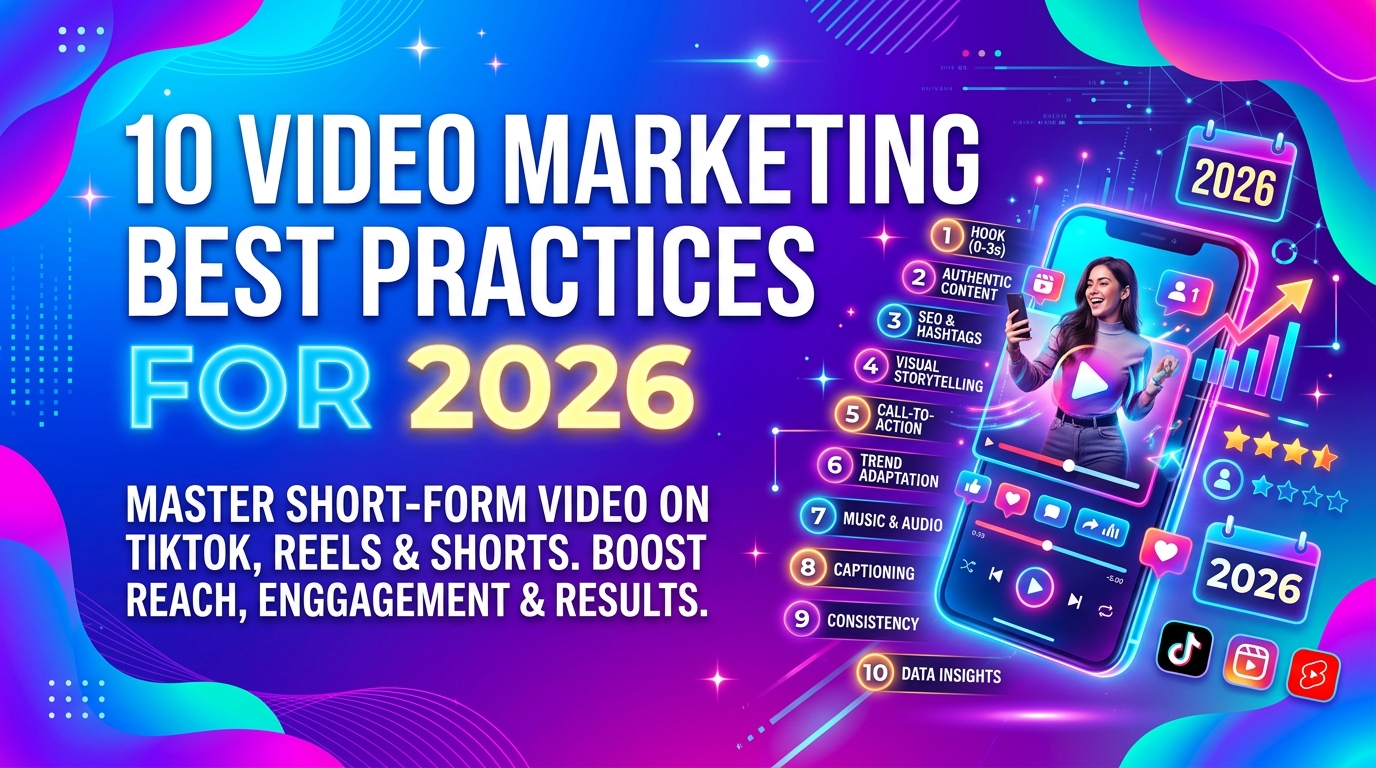
Stop guessing. Video is projected to account for 82% of all internet traffic by the end of 2025↗, which tells you something simple. Video marketing best practices aren't a side topic anymore. They're the operating system for how brands, creators, and small teams get attention online.
Most bad advice about short-form video sounds clean but fails in the feed. “Be authentic.” “Post consistently.” “Follow trends.” None of that helps if your TikTok dies in the first second, your Reels text gets covered by interface buttons, or your Shorts feel polished but forgettable. Platforms reward specifics. So should your process.
The other shift is speed. Teams that publish well don't just have good ideas. They have a repeatable production system. That matters even more now that many creators use AI to draft scripts, generate visuals, add voiceovers, and batch edits. Used well, AI cuts production drag. Used badly, it creates content that looks technically fine and emotionally empty.
This guide stays practical. You’ll get platform-aware tactics for TikTok, YouTube Shorts, and Reels, plus templates you can copy, adapt, and test. Some of these are creative decisions. Some are packaging decisions. Some are workflow decisions. All of them affect reach.
A good short-form strategy doesn't rely on luck. It relies on making better choices, faster, then repeating what proves itself in the data. Start with the first frame.
1. Hook Viewers in the First 3 Seconds
If the opening doesn't earn attention, nothing after it matters. Short-form feeds are ruthless. People don't decide whether your video is “good.” They decide whether it's worth stopping for.
Start with friction, surprise, or immediate relevance. A weak intro sounds like this: “Hey guys, today I want to talk about…” A stronger intro sounds like this: “Your Reels are probably losing viewers because of this one framing mistake.” The second version creates tension and a reason to keep watching.

TikTok favors quick payoff. Reels often respond well to curiosity-led text overlays. YouTube Shorts can support a slightly more direct, information-first open, especially if you're teaching something specific. The mistake is using the same hook style everywhere.
Hook formats that still work
Use one of these structures when you're scripting:
- Call out the problem: “Your product video looks expensive, but it still doesn't convert.”
- Open with contrast: “This ad took minutes to make, but it doesn't look rushed.”
- Lead with a claim: “Most creators ruin retention before the first sentence ends.”
- Use a visual switch: before/after, zoom-in, screen change, or abrupt scene cut.
- Ask a sharp question: “Why are people watching but not following?”
Practical rule: Match the hook to the payoff. If you promise a twist, reveal one. If you promise a fix, give one fast.
Creators using DailyShorts can speed up hook testing by generating multiple script openings for the same topic, then producing several versions instead of betting on one. That's one of the few AI uses that consistently saves time without hurting quality.
A simple copy-paste hook template:
“If you're posting about [topic] and getting ignored, fix this first.”
Use this later in the item to see what strong hooks feel like in motion:
What doesn't work is fake urgency. “Watch until the end” with no payoff trains people to leave. Strong hooks create a promise. Good videos keep it.
2. Optimize for Vertical Video Format 9 16 Aspect Ratio
Vertical is the default viewing behavior on TikTok, Reels, and Shorts. If the frame looks cropped from a YouTube video or webinar replay, viewers feel it right away. The content looks recycled, and recycled usually loses.
9:16 is not just an export setting. It changes how you script, shoot, frame, and place text. Creators who treat vertical as a production constraint get cleaner visuals, stronger retention, and fewer painful re-edits later.
Frame for the phone, not the editing monitor
Keep the subject in the safe center area. Platform captions, buttons, usernames, and CTAs eat space at the top and bottom, and edge placement gets covered fast. A product demo can still be well shot and lose because the feature being shown sits under the interface.

Use these framing rules in practice:
- Keep faces and products centered: Leave margin on both sides so important details survive platform cropping.
- Reserve text-safe zones: Leave space at the top for headlines and at the bottom for captions or app UI.
- Shoot tighter: Close-ups and medium-close shots read better on a phone than wide, detail-heavy scenes.
- Preview on an actual device: Export a draft and watch it inside the app before publishing.
The trade-off is simple. Wide shots give context, but they waste screen space on mobile. Tight framing feels more native, though it demands cleaner composition and stronger lighting because viewers notice every mistake.
A practical workflow helps. Script with vertical in mind, stack visuals top to bottom, and write on-screen copy that fits in short lines. If you need faster first drafts for short-form concepts, a TikTok script generator for vertical-first content planning↗ can help you map scenes before you shoot.
Here’s a copy-paste framing template for short-form videos:
- Top zone: 3 to 6 word headline
- Center zone: face, product, or core action
- Lower middle: demo steps, proof, or caption support
- Bottom zone: leave clear for app UI and CTA overlap
Native-looking vertical video usually beats footage that was originally designed for another format and cropped later. Higher production quality does not save bad framing. Clean mobile composition does.
3. Leverage Pattern Interrupts and Trend Cycles
The feed trains people to scroll on autopilot. Pattern interrupts break that rhythm. A sudden camera move, a strange first frame, a familiar trend used in an unfamiliar niche, or an unexpected line of text can all buy you the extra second you need.
Trends help because the audience already recognizes the format. That lowers friction. But trend-chasing without a point makes your content blend in with everything else.
Borrow the format, keep your angle
A fitness creator can use a trending sound to show gym mistakes. A software founder can use that same sound to show landing-page mistakes. A local bakery can use it for “what customers think happens vs what happens at 5 a.m.” The trend is the wrapper. Your perspective is the reason to watch.

The window is usually short. That's why speed matters. If you're adapting trends regularly, a TikTok script generator↗ can help you turn one trend into several niche-specific versions without rewriting from scratch every time.
Try this simple trend adaptation template:
- Trend setup: use the familiar sound, POV format, or visual meme
- Niche twist: connect it to a pain point your audience already has
- Payoff: teach, reveal, or compare something useful
- CTA: ask for a comment, save, or follow only if the video earns it
A practical example: A marketing consultant uses a “things I’d never do” trend. Instead of generic opinions, the video lists three paid ad mistakes that waste budget. That works because the format feels current, but the content still says something.
What doesn't work is jumping on every trend. Trend alignment matters more than trend volume. If a sound fights your brand voice or confuses your audience, skip it. You don't need to look current at the cost of looking random.
4. Use Strategic Text Overlays and On Screen Text
Videos with weak text lose viewers fast. On short-form platforms, on-screen words often do three jobs at once. They stop the scroll, clarify the point, and keep the viewer oriented as the clip moves.
Silent viewing is part of the reality, but the bigger mistake is treating captions and overlays as the same thing. They are not. Captions translate speech. Overlays direct attention. Strong videos use both with intent.

Make text earn its place
Every line on screen should have a specific job:
- Hook text: the promise or tension point in the first frame
- Section text: labels like “Mistake 1” or “Step 2” that keep pacing clear
- Proof text: numbers, outcomes, or short examples that make the claim believable
- CTA text: a light prompt such as “save this” or “comment ‘guide’”
That structure works across platforms, but the execution changes. TikTok rewards bigger, faster text that lands immediately. Reels usually need cleaner placement because interface elements crowd the screen. Shorts often perform better with simpler phrasing and fewer words per frame.
Here’s a practical layout I use for educational clips:
- Top third: headline or promise
- Middle: one key phrase per beat
- Bottom safe area: readable captions, clear of platform UI
A copy-pasteable overlay sequence for a 20-second tip video looks like this:
- 0 to 2 seconds: “3 fixes for low watch time”
- 3 to 6 seconds: “1. Your intro takes too long”
- 7 to 11 seconds: “Show the result before the explanation”
- 12 to 16 seconds: “2. Put one idea on each screen”
- 17 to 20 seconds: “Save this and test it today”
AI provides a useful way to save time. A video subtitle generator for short-form captions and timing↗ can handle the repetitive production work. Then you can spend your effort on hierarchy, phrasing, and placement, which is where retention usually improves.
Keep the trade-off in mind. More text can increase clarity, but too much text forces people to read instead of watch. If the viewer has to choose between your face, your demo, and a paragraph on screen, the video gets harder to follow.
Good overlay writing is short, specific, and visual. “Stop doing this in ads” beats “Here are a few things to consider if your advertising performance is not where you want it to be.” Cut filler. Keep the words that change behavior.
5. Implement Consistent Posting Schedule and Content Series
Creators who publish on a real schedule get more useful feedback, faster. The gain is not volume for its own sake. It is pattern recognition. After a few weeks of consistent posting, you can spot which hooks hold attention, which formats bring saves, and which topics die on arrival.
A schedule only works if it is sustainable. Daily posting sounds good until quality drops, editing piles up, and the series disappears after ten days. Teams and solo operators often find that three to five short videos a week is enough to build momentum without turning content into a scramble.
Series solve the bigger problem. They turn content from constant reinvention into a repeatable system.
Build repeatable shows, not isolated posts
A good series has a clear promise, a fixed format, and one job on the platform. I usually want each series to do one of three things: reach new viewers, build authority, or convert warm viewers into leads or buyers. Mixing all three goals into every post makes the content muddy.
A simple weekly setup looks like this:
- Monday: myth-busting clip for reach
- Wednesday: tutorial or screen-share tip for saves
- Friday: reaction, teardown, or case lesson for trust
That structure gives you consistency without creative burnout. It also makes production easier because the format stays stable even when the topic changes.
This is also where AI earns its keep in a practical way. DailyShorts can help generate draft scripts, cut raw footage into platform-ready clips, and schedule posts in batches. That reduces the admin work that usually breaks consistency. Your time goes to angle, examples, and sharper hooks.
Platform fit matters here. On TikTok, a recurring opinion or myth series often performs well because viewers reward recognizable personalities and fast takes. On Instagram Reels, visual repeatability matters more. A named series with consistent cover text and framing can help viewers recognize your posts in-feed. If you need examples, this list of High-Impact IG Reels Ideas↗ is a useful starting point for building repeatable formats.
A simple series template
Name the series so the viewer immediately knows what they are getting:
“30-Second Fix”
“Brand Breakdown”
“One Mistake Costing You Sales”
Then lock in the structure. Example:
- Hook: call out the problem
- Middle: give one fix or one example
- End: ask for a specific next action
Random posting usually fails because there is no feedback loop. A schedule gives you enough reps to improve. A series gives viewers a reason to come back. Together, they turn short-form video into an actual publishing system instead of a stack of isolated posts.
6. Create Educational or Value Driven Content with Clear CTAs
Educational short-form video works because it gives the viewer a win before asking for attention, a click, or a sale. On most platforms, that trade is still the cleanest path to trust.
The format is simple. Teach one useful thing. Prove it quickly. End with one next step that matches the goal of that specific video.
Creators lose conversions here by trying to cram too much into one clip. A 30-second video should solve one narrow problem, not deliver a full masterclass. If the topic is bigger, turn it into a sequence. One video explains the mistake. The next shows the fix. The third handles the objection that usually stops people from taking action.
That structure also works well with AI-assisted production. DailyShorts can help turn a longer idea into a tighter script with one lesson, one example, and one CTA. If you need help packaging that final line for TikTok, a TikTok description generator↗ can speed up drafting without flattening your voice.
Use a one-problem, one-action framework
A strong value-driven short usually follows this order:
- Problem: name the pain point fast
- Lesson: give one clear takeaway
- Example: show proof, process, or before-and-after
- CTA: ask for one action only
Examples:
- Coach: “If your webinar drop-off is high, your pitch is probably too early. Teach for 10 more minutes, then transition. Follow for part two.”
- Ecommerce brand: “This organizer fixes tangled cables in under a minute. Here’s how it fits in a carry-on. Save this for your next trip.”
- Consultant: “Your landing page headline is too vague. Say what the buyer gets and how fast. Comment ‘headline’ and I’ll post examples.”
Platform fit matters. TikTok rewards direct teaching with a strong opinion or fast correction. Instagram Reels usually benefits from cleaner visual demos, tighter cover text, and save-focused CTAs. If you want more angle ideas for Instagram specifically, this roundup of High-Impact IG Reels Ideas↗ is useful.
The CTA should match the role of the video. Top-of-funnel posts should ask for a follow, save, or comment. Mid-funnel posts can push to a lead magnet, product page, or link in bio. Bottom-funnel posts can ask for the sale directly, but only after the video has already done the work of making the offer feel obvious.
One ask is enough.
“Follow for more.” “Comment ‘guide.’” “Save this checklist.” “Get the full template in bio.” Those all work because they are specific and low-friction. A pileup of asks makes the close weaker, not stronger.
7. Optimize Hashtags and Keywords for Discoverability
Search drives a bigger share of short-form views than many creators admit. On TikTok, Reels, and Shorts, discovery often starts with the words wrapped around the video, not just the clip itself.
Hashtags help with categorization. Keywords help platforms understand intent. The best results come when your spoken hook, on-screen text, caption, and tags all use the same language. If your video teaches client onboarding, the packaging should say client onboarding clearly instead of hiding behind vague tags like #fyp or #business.
A tighter tag stack works better than a long messy one. Use a small set with a job for each tag:
- Topic tags: client onboarding, email marketing, meal prep
- Audience tags: freelancers, creators, small business owners
- Format tags: tutorial, breakdown, checklist
- Brand or series tags: your recurring content format or named framework
Here is the trade-off. Broad hashtags can expose you to larger pools, but they also drop you into heavier competition and weaker viewer intent. Specific hashtags usually reach fewer people up front, but the match is better, which improves watch time, saves, and follow-through.
For example, a freelancer posting a video on onboarding a new client would get more from language like “client onboarding process,” “freelance systems,” and “proposal workflow” than from generic tags built for vanity reach. The caption should repeat that phrasing in plain English. Say what the video solves, who it helps, and what the viewer will get.
If you want speed without turning your captions into AI sludge, use a first draft tool and then edit with intent. This TikTok description generator for keyword-rich captions↗ is useful for building a starting structure fast. I would still trim anything generic, swap in the exact phrasing your audience uses, and cut every tag that does not match the clip.
Specific packaging gets found by the right viewer. Generic packaging gets buried.
One more rule that saves time. Do not copy a competitor's hashtag block line for line. Their account authority, comment history, and audience behavior are different from yours. Study their wording patterns, then build your own keyword set around your angle, offer, and platform.
8. Use Trending Sounds and Music for Audio Branding
Videos with weak audio lose people fast. On short-form platforms, sound sets pace, mood, and recall before the viewer has fully read your text or processed the visual.
The mistake is using trending sounds as a shortcut. They can help distribution, but they can also make your brand blur into everyone else's feed. The better play is to use trends selectively, then build a repeatable audio identity around them.
Platform behavior matters here. TikTok and Instagram Reels still reward content that feels native to the current sound culture. YouTube Shorts usually gives more room to direct voice-led delivery, especially for educational clips. One edit should not be copied across all three and expected to perform the same way.
A simple rule works well in practice. If the sound is carrying the joke, reaction, or format, use the trend. If the value is in the explanation, keep the music low and let the voice lead. Viewers should remember your point, not just recognize the audio.
Build an audio system, not random picks
Strong creators usually work from a small sound palette:
- One or two recurring background tracks for tutorials, explainers, or product demos
- A handful of transition sounds for cuts, reveals, or before-and-after moments
- Selective trending audio only when it fits the format and audience expectation
- Consistent voice treatment so your clips sound like they came from the same creator
That last piece gets overlooked. If you use AI voiceovers, the convenience is real, but flat delivery kills retention. Edit the script for spoken rhythm. Add pauses. Cut stiff phrasing. Swap generic lines for specific opinions or lived details. Tools like DailyShorts can speed up production, but the final pass still needs a human ear.
Here is a platform-specific blueprint:
- TikTok: Use trending audio early, but keep your spoken hook clear in the first line
- Instagram Reels: Favor polished music beds and clean transitions that support visual pacing
- YouTube Shorts: Prioritize clarity, stronger voice presence, and lower dependence on trend audio
A copy-pasteable decision filter helps:
- Use this sound if: it supports the format, fits the audience, and does not overpower the message
- Skip this sound if: people will remember the trend but forget the takeaway
- Save this sound for later if: it is rising, but you do not yet have a concept that matches it
Audio branding works through repetition. Reuse enough sonic elements that returning viewers start to recognize your clips without seeing your handle first. That kind of recall is hard to fake, and it compounds over time.
9. Test Measure and Iterate Based on Analytics Data
Creators who improve fastest usually win more distribution than creators who only publish more. The gap comes from review habits. Good analytics work shows which hook held attention, which edit lost people, and which topic earned a meaningful action such as a save, share, profile visit, or click.
Start simple. Compare videos that had the same job.
If two clips covered the same topic and one clearly outperformed the other, inspect the inputs in order. Check the first line. Check the opening visual. Check text density. Check pacing in the first five seconds. In short-form, weak retention usually starts early, so review the opening before you blame the CTA at the end.
Test one variable at a time
Use a clean test structure so the result means something:
- Same topic, different hook
- Same hook, different CTA
- Same script, different opening visual
- Same concept, different edit for each platform
That last one matters more than many teams admit. A TikTok cut may need faster visual turnover and looser delivery. A YouTube Short often benefits from tighter explanation and cleaner framing. An Instagram Reel may need stronger cover text and a more polished first frame. The idea can stay the same while the packaging changes by platform.
A practical example makes this easier to apply.
A business educator posts three versions of the same concept. Version one opens with a question. Version two opens with a common mistake. Version three opens with a result. The mistake-led version holds viewers longer and earns more saves. That version becomes the control. The next five videos in that content category use the same opening structure, then test only one new variable at a time.
This is also where AI helps if you use it with discipline. Tools that generate multiple edits quickly can save hours, but speed only matters if the test is organized. If you are experimenting with character-led content or synthetic presenters, AI influencer video workflows↗ can help produce variations fast enough to compare hooks, pacing, and CTA styles without rebuilding each video from scratch.
Do not react to one outlier. Look for patterns across a batch of posts.
If tutorials repeatedly earn saves, that format is doing the trust-building work. If trend-based clips pull reach but weak profile actions, treat them as awareness content. If direct opinion videos trigger comments but lower completion, tighten the runtime instead of abandoning the angle. The point is to sort content by job, then judge it against the right metric.
Changing everything at once ruins the lesson. If you swap the topic, hook, music, caption style, and CTA in a single test, you will have no idea what caused the result.
10. Build Community Engagement and Respond to Comments
A comment section is not cleanup work. It's part of distribution, feedback, and content development. When viewers comment, they're telling you what confused them, what landed, what they want next, and what language they use to describe the problem. That's valuable.
The best part is that engagement compounds. One thoughtful reply can trigger more comments. One common question can become tomorrow's video. One disagreement can reveal the exact angle your next post should address.
Turn comments into a content engine
Good prompts invite response without sounding needy. “Agree?” is weak. “Which one are you doing right now?” is better. “What's the biggest reason you stop watching a Reel?” is better still because people can answer from experience.
If you're scaling with automated production or scheduled posting, leave space for manual interaction. That's where audience trust gets built. A tool like AI influencers↗ can support creative experimentation around character-led content, but actual comment interaction still benefits from a real human reading the room.
There's a strong strategic reason to take this seriously. Interactive video increases engagement by 591% compared with linear video↗. You won't turn every short into a full interactive experience, but the principle holds. The more the viewer participates, the more likely they are to stay connected.
Reply videos are underrated. They give you a built-in topic, a built-in hook, and proof that real people care enough to ask.
What doesn't work is treating comments as vanity. If viewers take the time to respond and you never meet them there, you're leaving attention, ideas, and goodwill on the table.
10-Point Video Marketing Comparison
| Tactic | Complexity 🔄 | Resources ⚡ | Expected outcomes 📊 ⭐ | Ideal use cases 💡 | Key advantages ⭐ |
|---|---|---|---|---|---|
| Hook Viewers in the First 3 Seconds | Medium 🔄, creative testing required | Low–Medium ⚡, basic editing, assets, script variations (DailyShorts helps) | High 📊, ↑ completion rate and algorithmic reach | Any short-form where instant attention matters | Immediate attention; platform-agnostic; increases virality |
| Optimize for Vertical Video Format (9:16) | Low–Medium 🔄, template setup needed | Moderate ⚡, vertical assets, framing tools (DailyShorts auto 9:16) | High 📊, better retention, avoids UI cutoffs | Mobile-first platforms; repurposed content | Maximizes screen real estate; consistent perceived quality |
| Leverage Pattern Interrupts and Trend Cycles | Medium–High 🔄, constant trend monitoring | Low–Medium ⚡, quick production, trend tools, Auto Pilot for scaling | High but short-lived 📊, rapid spikes in discoverability | Trend-driven campaigns; rapid growth attempts | Fast reach; lower effort to ride viral trends |
| Use Strategic Text Overlays and On‑Screen Text | Low 🔄, design and timing discipline | Low ⚡, captioning tools, readable fonts (auto-synced by DailyShorts) | Moderate–High 📊, ↑ comprehension, retention, accessibility | Educational content; muted-viewing environments | Improves clarity and inclusivity; boosts engagement |
| Implement Consistent Posting Schedule and Content Series | Medium 🔄, planning and discipline required | Moderate ⚡, batching, calendar, scheduling tools (Auto Pilot) | High long-term 📊, steady growth and algorithm favorability | Brands/creators aiming for sustained growth | Builds habits, reduces fatigue, enables measurement |
| Create Educational or Value‑Driven Content with Clear CTAs | Medium 🔄, requires expertise and clear structure | Moderate–High ⚡, research, scripting, CTA design (DailyShorts scripts) | High 📊, ↑ saves/shares, stronger conversions | Thought leadership, product education, conversion funnels | Builds authority; drives high‑value engagement and conversions |
| Optimize Hashtags and Keywords for Discoverability | Medium 🔄, ongoing research and testing | Low ⚡, hashtag tools, analytics (Auto Pilot tagging) | High 📊, significant reach uplift for niche creators | New creators, niche targeting, SEO-focused videos | Cost‑effective discoverability; better ranking in feeds |
| Use Trending Sounds and Music for Audio Branding | Low–Medium 🔄, timely audio selection and sync | Low ⚡, audio libraries, editing, AI voiceovers (DailyShorts) | High short-term 📊, algorithmic boost and shareability | Entertainment, branded jingles, trend remixes | Enhances memorability; drives shares and duets |
| Test, Measure, and Iterate Based on Analytics Data | High 🔄, disciplined A/B testing and review cycles | Moderate ⚡, analytics tools, testing volume, aggregated data | High compounding 📊, improved ROI and replicable winners | Data-driven scaling and optimization | Removes guesswork; accelerates performance gains |
| Build Community Engagement and Respond to Comments | Medium 🔄, continuous time investment | Low–Medium ⚡, dedicated time/team, engagement features | High retention 📊, loyalty, repeat views, stronger signals | Community-focused creators and brands | Generates UGC and social proof; favors algorithmic reach |
Your Blueprint for Dominating Short Form Video
Short-form platforms make the decision fast. Viewers scroll in seconds, and the creators who keep winning are usually following a repeatable production system, not chasing random bursts of inspiration.
That system is the primary advantage.
The practices in this guide work best when they operate together. A strong hook gets the stop. Vertical framing keeps the composition native. Pattern interrupts hold attention. On-screen text improves clarity with the sound off. Series formats create return viewing. Analytics review shows what deserves another version. The result is a workflow you can improve each week instead of a pile of disconnected posts.
This is also where platform-specific execution matters. TikTok rewards speed, personality, and cultural timing. Reels tends to reward cleaner packaging and stronger visual polish. Shorts often gives more room for direct teaching and search-friendly phrasing. One idea can work across all three, but the opening line, pacing, caption, and edit usually need to change.
Creators who scale this well treat content like a testing program. They keep a small bank of proven hooks, a few repeatable series, clear visual rules, and a post-publish review process. That makes it easier to tell whether a miss came from the topic, the first frame, the delivery, or weak audience fit.
AI helps with the boring parts, which is exactly where many teams lose time. Use it to draft variations, resize for 9:16, generate rough cuts, build captions, and queue posts. Keep the final judgment human. Audience empathy, taste, examples, and timing still decide whether a video feels worth watching. Tools like DailyShorts are useful here because they reduce production drag without deciding the creative angle for you.
A practical setup looks like this. Build one core idea. Cut three intros for three platforms. Turn the strongest angle into a short series. Review saves, comments, rewatch points, and drop-off. Then revise the next batch based on actual behavior, not guesswork.
If you want another platform-specific reference point, this guide to 8 essential Instagram Reels best practices↗ is worth comparing against your own results.
Short-form growth rarely comes from one breakthrough clip. It comes from consistent packaging, fast feedback, and disciplined iteration. Do that for a few months and the accounts that looked "lucky" start to look very easy to explain.
If you want a faster way to turn ideas into short-form content, DailyShorts↗ can help you script, generate, edit, and schedule vertical videos for TikTok, YouTube Shorts, and Reels without building the whole workflow manually.
Ready to create viral videos?
Start creating viral TikTok and YouTube Shorts with DailyShorts AI today.