How to Grow Small Business: A 2026 Playbook
DailyShorts AI
You’re probably in a familiar spot. Sales are coming in, but not predictably. Marketing feels fragmented. One week you’re posting on social media, the next you’re chasing referrals, then you’re reworking your website because someone told you that’s the growth lever.
That confusion is normal. Small business owners don’t usually struggle because they’re lazy or untalented. They struggle because they’re trying to grow with a patchwork of tactics instead of a system.
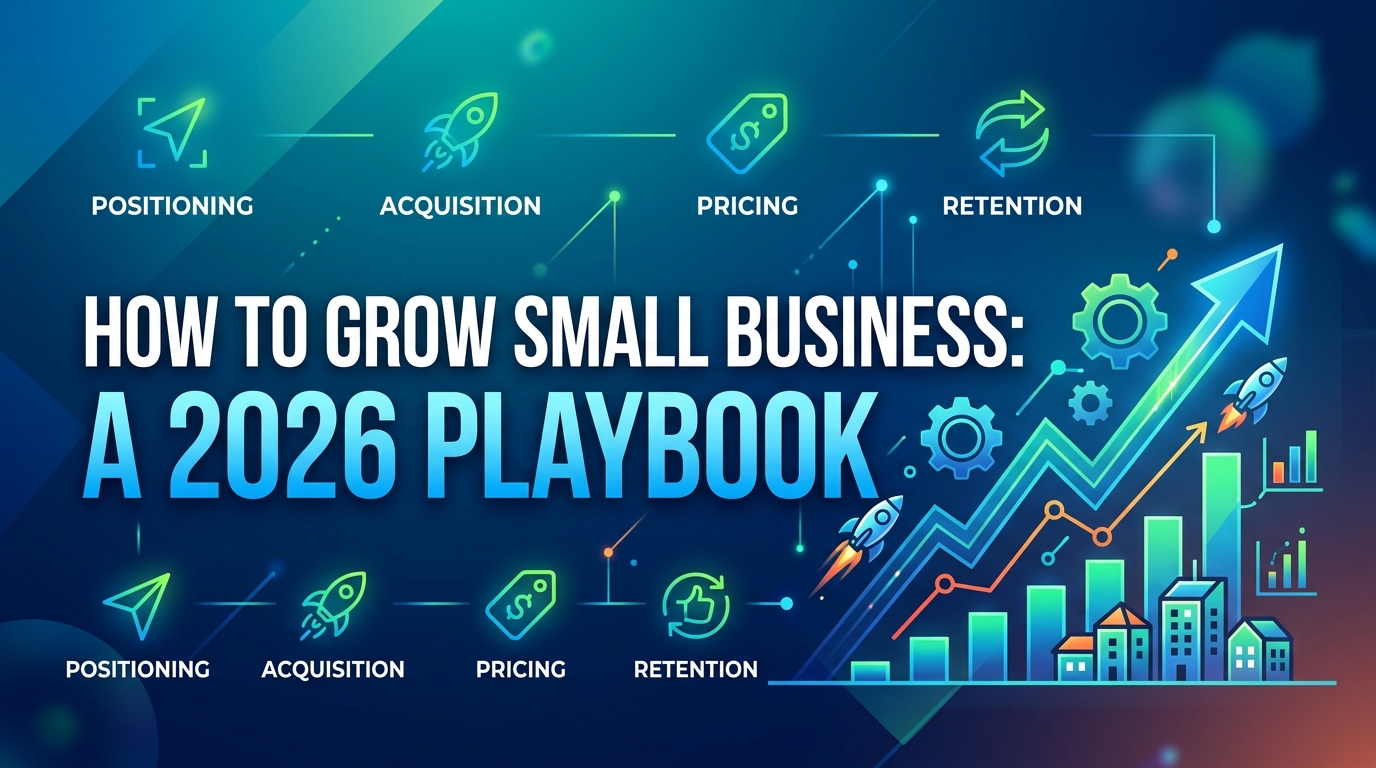
If you want to know how to grow small business in 2026, start with this: the old playbook isn’t enough. You can’t rely on occasional word of mouth, random posting, and discounting your way into stable growth. You need positioning that makes you easy to choose, acquisition that runs consistently, operations that don’t collapse under demand, and retention that turns buyers into advocates.
The Modern Growth Imperative
Most owners feel pressure from two directions at once. They need more customers, but they also need more margin, more consistency, and less chaos. Growth without control feels like drowning with better branding.
That’s why the modern growth conversation has to start with reality. Small businesses represent 99.9% of all U.S. businesses and drive up to 50.7% of the nation’s GDP, yet more than 543,000 new businesses open monthly, which makes competition relentless according to USAFacts research on the role of small businesses in the economy↗. Opportunity is massive. So is the noise.
A lot of traditional advice still assumes you’ll grow by adding more effort. More networking. More posts. More offers. More hours. That approach breaks fast because small businesses don’t have unlimited time, staff, or creative energy.
Practical rule: Don’t ask, “How do I do more marketing?” Ask, “What growth engine can I run consistently with the team, budget, and attention I actually have?”
In practice, that means replacing heroic effort with repeatable systems. It means choosing a small number of channels and running them well. It means using tools that cut production time, reduce bottlenecks, and let a small team show up like a much bigger one.
If you want a grounded view of how digital channels fit into that shift, Click Click Bang Bang’s guide to digital marketing for small business↗ is a useful reference because it reinforces the point many owners miss. Growth isn’t one tactic. It’s alignment between message, channel, offer, and follow-up.
You also need a learning loop. Businesses that improve fastest aren’t always the most funded. They’re usually the ones that review what worked, cut what didn’t, and publish or sell again without drama. For that kind of thinking, the DailyShorts blog↗ is worth browsing for ideas around short-form content workflows and modern attention capture.
Find Your Unfair Advantage Through Positioning
Most small businesses don’t have a lead problem first. They have a clarity problem.
If your message is broad, your content gets ignored. If your offer is fuzzy, prospects compare you on price. If you try to serve everyone, you sound like everyone else. Positioning fixes that.

Start with a narrow ideal customer
Don’t build your growth plan around “small businesses,” “busy professionals,” or “anyone who needs help.” Those are categories, not customers.
A useful Ideal Customer Profile, or ICP, has enough detail that you can write directly to one type of buyer. You should know what triggers them to look for help, what alternatives they’ve already tried, and what result matters most to them. In my experience, owners get this wrong by describing demographics and skipping buying behavior.
Use questions like these:
- What event creates urgency: Did the customer just lose traffic, miss a sales target, launch a product, or get overwhelmed by content demands?
- What are they replacing: Are they moving away from DIY, a freelancer, a bloated agency, or inconsistent internal processes?
- What do they value most: Speed, simplicity, control, better quality, lower risk, or faster execution?
- What would make them say no: Budget, timing, trust, technical complexity, or unclear ROI?
An ICP should feel restrictive. That’s a good sign. Broad targeting makes marketing expensive because you have to explain too much to too many people.
One practical shortcut is to study the customers who act quickly. They often reveal your real market faster than your longest list of followers.
Validate demand before you scale it
Too many businesses invest in branding, web design, hiring, and content volume before confirming people want the offer.
That’s dangerous because 42% of small businesses fail due to lack of market demand, as noted in the U.S. Chamber guide on why small businesses fail↗. That single number should change how you make decisions. Validation comes before expansion.
Here’s what works better than guessing:
-
Talk to buyers directly
Run simple interviews or surveys with people who match your ICP. Ask what they’re trying to solve, what they’ve tried, what frustrated them, and what “good” looks like. -
Test a focused offer
Don’t launch five services. Launch one offer with one promise for one buyer group. -
Watch behavior, not compliments
People say nice things about ideas they’ll never buy. Real validation looks like booked calls, replies, signups, and purchases. -
Study adjacent signals
Reviews, comment sections, competitor offers, and repeated objections often reveal where the actual demand sits.
Positioning gets stronger when you stop asking, “Would people like this?” and start asking, “Will this exact customer pay for this exact outcome now?”
If you want to experiment with audience concepts or visual personas for campaigns, tools like AI influencers for creative testing↗ can help you pressure-test how a niche, tone, or content style might land before you spend heavily on production.
Build a value proposition people remember
Once you know your customer and you’ve validated demand, write a Unique Value Proposition, or UVP. Keep it short enough to use on your homepage, in video hooks, and in sales calls.
I like a simple 4U filter. Your message should be:
| 4U element | What it means | Bad example | Better example |
|---|---|---|---|
| Useful | Solves a real problem | We offer tailored solutions | We help local service businesses turn missed inquiries into booked jobs |
| Urgent | Matters now | Improve your brand presence | Get a weekly flow of leads without waiting months for referrals |
| Unique | Shows why you’re different | Full-service support | Done-for-you short-form video built for platform-native distribution |
| Ultra-clear | Easy to understand fast | Transformative growth systems | Content that explains, attracts, and converts in under a minute |
A strong UVP often follows this template:
We help [specific customer] achieve [specific result] without [main pain or obstacle].
Examples:
- We help local clinics generate consistent inquiries without relying on last-minute promotions.
- We help ecommerce founders turn product benefits into short videos without hiring an editor.
- We help consultants build authority with educational content without spending hours scripting every post.
Clarity compounds. Once your positioning is right, every channel gets easier. Ads improve. Sales calls shorten. Content lands faster. Referrals become more precise because people know exactly who to send your way.
The Modern Customer Acquisition Machine
Customer acquisition used to tolerate inconsistency. A decent website, some referrals, maybe a few ads, and a monthly email could carry a small business for a while.
That’s no longer enough. Attention is fragmented, buyers research independently, and most businesses are fighting for the same limited moments of interest. If you want a practical answer to how to grow small business today, build an acquisition machine around content that earns attention before the sales conversation starts.
This process flow captures the model well.

The strongest channel for most small businesses right now is short-form video. Not because it’s trendy, but because it compresses trust-building. In less than a minute, you can show expertise, explain a problem, answer an objection, and point the viewer toward a next step.
That matters because marketing is the top growth strategy for 50% of small businesses, social media can generate 60% more leads, and 43% of businesses use AI for marketing, according to The Zebra’s small business statistics roundup↗. The takeaway isn’t “post more.” It’s that modern acquisition belongs to businesses that can produce relevant content consistently.
Why short-form video outperforms static promotion
A brochure-style post tells people what you do. A short video shows them why it matters.
When an owner says, “We tried social media and it didn’t work,” what they usually mean is they posted generic updates with no hook, no point of view, and no system behind them. That’s not a channel problem. That’s an execution problem.
Short-form video works especially well because it can do three jobs at once:
- Attract cold attention through a sharp opening line
- Qualify viewers by speaking to a specific pain point
- Move action with a direct next step, such as booking, subscribing, or visiting a product page
Most small businesses don’t need more channels. They need one channel they can feed every week without burning out.
That’s where AI earns its place. Not as a gimmick. As an advantage.
Build a content system, not isolated posts
Random creativity is not a growth plan. You need a weekly production workflow that turns customer questions into assets.
A simple system looks like this:
-
Collect problems from the market
Pull from sales calls, support emails, comments, objections, and reviews. -
Turn each problem into multiple angles
One pain point can become a direct answer, a myth-busting post, a founder opinion, and a before-after contrast. -
Batch production
Script, record, edit, and schedule in one block instead of doing each task daily. -
Distribute by platform behavior
The same core idea can be adapted for TikTok, Reels, and Shorts with different hooks or captions. -
Review retention and response
Don’t obsess over vanity metrics. Look at which topics produce comments, saves, clicks, and qualified inquiries.
For businesses handling verification flows, marketplace testing, or campaign ops across regions, setup friction can slow execution. In those cases, tools like secure virtual numbers↗ can help teams manage account access and testing workflows without mixing personal numbers into business systems.
Here’s a useful benchmark for your workflow quality: if content creation depends on one person feeling inspired, the system is broken.
The three video formats that pull customers in
You do not need endless creativity. You need a few reliable formats.
Problem and solution clips
These are your direct-response assets. They name a pain clearly and point to a fix.
Examples:
- Why your website gets visits but not inquiries
- Why your salon promotions stop working
- Why customers say they’re interested and then disappear
These work because the viewer immediately recognizes themselves. Strong hooks are specific and uncomfortable in a productive way.
Use this structure:
- Hook: Name the painful pattern
- Agitation: Explain why it keeps happening
- Solution: Give one practical shift
- CTA: Invite the next step
Educational how-to videos
These build authority. They’re especially good for service businesses, consultants, educators, and product-led brands.
Topics might include:
- How to choose the right service package
- How to prepare before your first consultation
- How to spot a weak offer before you waste ad spend
Educational content works best when it solves a small piece of a larger problem. Don’t try to teach everything. Teach enough that the buyer trusts your thinking.
A good rule is to answer the question behind the question. If someone asks about pricing, they’re often really asking about risk. If they ask about timing, they may be asking whether your process is reliable.
The embedded video below is a good reminder that practical instruction is often the fastest route to trust.
Trend-aware content
Many businesses either overdo it or avoid it entirely.
Trend-aware content does not mean lip-syncing because everyone else is. It means using a familiar format, angle, or conversation already circulating on a platform, then tying it back to your customer’s problem. You borrow attention, but you keep your message grounded in your offer.
Examples include:
- Reacting to a common industry misconception
- Using a viral format to illustrate a buyer mistake
- Turning a newsworthy shift into a practical takeaway for your audience
Done well, trend-aware posts widen reach without diluting trust.
What effective production looks like in real life
A small business owner usually has four bottlenecks with video: ideation, scripting, editing, and posting consistency. That’s why AI content tools matter now. They remove tasks that used to require a freelancer, editor, copywriter, and scheduler.
For teams focused on TikTok specifically, an AI TikTok video generator for rapid campaign production↗ can speed up the most expensive part of the process, which is getting from blank page to publishable asset fast enough to stay consistent.
The key trade-off is this. Speed helps only if your message is sharp. If your positioning is weak, AI will help you produce weak content faster. If your positioning is clear, AI lets you scale something that already works.
Use AI to accelerate:
- Script drafting from customer pain points
- Voiceover and visuals when you don’t want to appear on camera every day
- Variation testing so one idea becomes several creative executions
- Scheduling and repurposing across platforms
Don’t use AI to replace judgment. Keep the human part focused on angle, offer, audience, and final review.
Build Profitable Systems for Pricing and Operations
A lot of owners think growth problems are solved by selling more. Sometimes they are. Often they aren’t.
If pricing is weak or operations are messy, more customers just expose the cracks faster. You end up working harder for less margin, more support load, and a team that feels stretched.

Stop competing on cheap pricing
Low pricing feels safe because it seems easier to sell. In reality, it often creates bad customers, constant negotiation, and unstable cash flow.
The better move is value-based pricing. That means pricing around the result, relief, speed, convenience, or risk reduction you create. Buyers rarely choose purely on price when the outcome matters. They choose on confidence.
Ask yourself:
- What costly problem do we remove
- How quickly do we produce relief
- What extra effort does the customer avoid
- What confidence or simplicity do they gain
Then package your offer to reflect that value. Give buyers clear options. A simplified package usually sells better than a fully custom offer because it reduces decision fatigue for both sides.
Operator’s note: If every sales call ends with a pricing objection, your issue may not be the price. It may be that the buyer doesn’t understand the value or doesn’t trust the delivery.
Build systems before you add headcount
Many owners hire too early because hiring feels like progress. Sometimes it’s just an expensive workaround for broken processes.
That matters because roughly 25% of high-growth companies fail due to premature scaling, with common mistakes including hiring ahead of revenue and over-provisioning resources. Businesses that wait until they have stronger product-market fit and a cash-flow buffer have double the survival odds, based on LSA Global’s analysis of scaling pitfalls↗.
Before you hire, fix the workflow. Document the steps. Automate repeatable tasks. Reduce rework.
A lean operating stack usually includes:
- A CRM for lead and customer tracking
- A proposal or checkout flow that removes manual back-and-forth
- A project management tool to track fulfillment
- A standard onboarding sequence so every client starts the same way
- Templates for common responses, deliverables, and reporting
This is also the point where a pricing page matters more than many owners realize. Clear packaging and transparent plans reduce friction, shorten sales cycles, and help buyers self-qualify. Reviewing how structured software companies present plan differences can sharpen your own pricing logic. The DailyShorts pricing page↗ is one example of how clear packaging can reduce guesswork for the buyer.
Decide whether to hire or buy leverage
Use this simple decision filter.
| Situation | Better move | Why |
|---|---|---|
| Repetitive admin work | Automate first | Repetition is usually a process problem |
| Specialist task you rarely need | Contract or outsource | Full-time headcount creates fixed cost |
| Workload rising but process unclear | Document before hiring | Otherwise you hire confusion |
| High-value work blocked by volume | Add focused support | A targeted hire can remove a true bottleneck |
If the task happens the same way every time, software should probably handle part of it. If the task needs judgment, relationship-building, or creative problem-solving, a person adds more value.
Owners who scale well stay conservative on fixed costs and aggressive on system quality. That combination gives you room to absorb mistakes, seasonality, and experimentation without panicking.
Turn One-Time Buyers into Lifelong Fans
Most small businesses spend too much energy chasing the next customer and not enough improving the experience after the sale. That’s expensive, because trust is highest right after someone buys.
Think about a fictional customer named Maya. She runs a small online store, finds your business through a helpful video, buys a starter offer, and then waits. This moment matters more than most owners realize. If your follow-up is vague, delayed, or generic, enthusiasm drops fast.
If instead she gets a clean welcome email, a clear explanation of what happens next, and one immediate win, her confidence goes up. She starts to feel that she made a smart decision.
The first week sets the tone
The post-purchase experience should remove uncertainty. Buyers want to know three things right away:
- Did I make the right choice
- What happens next
- How do I get value quickly
A simple onboarding sequence does that better than a complicated one. For Maya, that might mean a welcome message, a short checklist, one tutorial, and a direct contact path if she gets stuck.
This is also where many brands miss a huge retention opportunity. They send logistics, but not reassurance. They deliver access, but not momentum.
A customer who feels progress in the first few days is easier to retain than one who gets a perfect explanation and no early result.
Stay present without becoming noisy
A few weeks later, Maya shouldn’t hear from you only when you want another sale. Strong retention comes from useful contact, not constant contact.
Good ongoing communication might include:
- Educational email sequences that help customers use the product or service better
- Short-form content that answers common next-stage questions
- Customer-only updates that make existing buyers feel like insiders
- Feedback prompts that ask what’s working and what’s confusing
Short-form scripts are useful here because retention content often needs to be concise and specific. If your team needs to turn recurring customer questions into quick educational assets, a TikTok script generator for short educational content↗ can help speed up that process.
The point isn’t to bombard buyers. It’s to keep helping after the transaction.
Turn satisfaction into advocacy
Now go back to Maya. She’s had a smooth onboarding, solved an early problem, and seen real value. This is the right moment to ask for more than a review.
You can invite:
- A testimonial if she’s articulate and happy
- A referral if she knows people with the same problem
- A second purchase if there’s a logical next offer
- Community participation if your brand has a customer group, event, or feedback circle
Retention gets stronger when customers feel seen. If Maya gives feedback and later notices you acted on it, she stops feeling like a transaction and starts feeling like part of the business’s progress.
That’s how one-time buyers become repeat customers. Then they become recommenders. Then they become the easiest source of warm demand you have.
Measure What Matters A Simple KPI Framework
A business can feel busy and still be unhealthy. That’s why measurement matters.
You do not need a complicated analytics stack to run a useful growth dashboard. A spreadsheet is enough if you track the right things consistently. The goal is simple. Know whether your acquisition, conversion, retention, and revenue quality are improving or slipping.
For owners selling online, reviewing frameworks around ecommerce KPIs for Shopify brands↗ can help sharpen what you monitor, especially if you’ve been relying on surface metrics like views or followers.
The small business growth dashboard
Track a small set of KPIs that connect directly to decisions.
| KPI | What It Measures | Simple Formula | Target Goal |
|---|---|---|---|
| Lead to customer rate | How well leads convert into buyers | Customers ÷ leads | Trending up over time |
| Customer acquisition cost | What you spend to win a new customer | Total marketing and sales spend ÷ new customers | Lower than customer value allows |
| Average order or project value | Revenue quality per sale | Total revenue ÷ total number of sales | Stable or rising |
| Repeat purchase rate | How often buyers come back | Repeat customers ÷ total customers | Trending up over time |
| Churn rate | How many customers stop buying or cancel | Customers lost during period ÷ customers at start of period | Trending down over time |
What to do when the numbers move
Metrics matter only when they trigger action.
If your lead to customer rate drops, check the offer first. Your traffic may be fine, but the message, sales process, or trust signals may be off. Review landing pages, sales calls, pricing presentation, and follow-up speed.
If customer acquisition cost rises, don’t immediately slash spend. Look at channel quality. Sometimes costs rise because targeting got broader, creative got stale, or your content stopped qualifying the right buyer.
If average order or project value falls, you may have a packaging problem. Buyers might be selecting the cheapest option because your higher-tier offer isn’t clearly differentiated.
If repeat purchase rate is flat, your customer journey likely ends too early. Add onboarding improvements, educational follow-up, stronger reactivation, or a better next offer.
If churn rate climbs, look for friction and disappointment. Customers leave when expectations and delivery drift apart, or when they stop seeing progress.
Track trends, not isolated moments. One bad week means little. A pattern over several weeks usually points to a real issue.
Keep the dashboard simple enough to use
The best KPI system is the one you’ll review every week. Keep it tight. One sheet. One owner. One recurring review.
A practical weekly rhythm looks like this:
- Update the numbers
- Note one win
- Note one concern
- Choose one action for the next week
That rhythm keeps you out of reactive mode. It also helps separate signal from noise. Growth rarely comes from one heroic move. It usually comes from making small, smart adjustments before problems turn expensive.
If you want to grow faster without turning content creation into a full-time job, DailyShorts↗ helps small businesses turn simple ideas into short-form videos for TikTok, YouTube Shorts, and Reels. It handles scripting, visuals, voiceover, editing, and scheduling so you can build a consistent acquisition engine without needing an in-house production team.
Ready to create viral videos?
Start creating viral TikTok and YouTube Shorts with DailyShorts AI today.